
Introduction
Making good gluten-free bread at home can be surprisingly difficult. Gluten-free dough behaves differently from traditional wheat dough because it does not develop the elastic gluten network that normally helps bread rise, hold its shape and produce a light texture. That is why choosing a bread maker with an appropriate gluten-free program can make a significant difference. The right machine can handle mixing, kneading, rising and baking with less manual work while helping you avoid some of the dense or uneven results that are common with unsuitable cycles.
In this guide, we compare seven bread makers that are worth considering for gluten-free baking in 2026. The list includes premium machines with dedicated gluten-free programs, models offering multiple gluten-free settings and more affordable choices for beginners. We will look at gluten-free programs, loaf capacity, kneading performance, temperature control, customization, ease of cleaning and overall value so you can choose a machine that fits your baking habits and budget.
Quick Comparison: 7 Best Bread Makers for Gluten-Free Bread
| Bread Maker | Best For | Gluten-Free Features | Capacity | Key Advantage |
| Zojirushi BB-PDC20 | Best Overall | Dedicated Gluten-Free course | 2 lb | Dual kneading blades and lid heater |
| Panasonic SD-R2550 | Best Gluten-Free Variety | 4 gluten-free programs | Up to about 1.1 kg | Temperature sensors |
| Breville BBM800XL | Best Customization | Dedicated Gluten-Free setting | Up to 2.5 lb | Custom cycle control |
| KBS 17-in-1 Bread Maker | Best Mid-Range Value | Gluten-Free program | Up to 2 lb | Many automatic programs |
| Cuisinart CBK-200 | Best Convection Option | Gluten-Free program | 2 lb | Convection baking |
| Hamilton Beach 29885 | Best Budget Pick | Gluten-Free setting | Up to 2 lb | Affordable and straightforward |
| Zojirushi BB-SSC10 | Best Compact Premium | Dedicated Gluten-Free course | 1 lb | Compact premium design |
What Makes a Bread Maker Good for Gluten-Free Bread?
Before looking at individual machines, it is important to understand what actually matters for gluten-free baking.
1. A dedicated gluten-free program
The most important feature is a genuine gluten-free setting. Traditional wheat-bread programs often include several stages of kneading, resting, rising, and sometimes punching the dough down before baking. Gluten-free recipes generally require a different process.
A dedicated gluten-free program is designed around those differences. For example, Zojirushi’s current Virtuoso Plus BB-PDC20 specifically includes a Gluten Free course among its menu settings, while the company also confirms that the BB-PDC20 and BB-SSC10 have designated gluten-free courses.
2. Good mixing and kneading
Gluten-free mixtures can be thick, sticky, or closer to a batter than conventional bread dough. A machine needs to mix ingredients thoroughly without leaving dry flour around the edges of the pan.
This is one reason dual-paddle machines can be attractive for larger gluten-free loaves. The Zojirushi BB-PDC20, for example, uses two kneading blades and an additional heater in the lid.
3. Consistent temperature
Temperature is another important factor because gluten-free bread can be sensitive to the timing of fermentation and baking. A machine that monitors temperature can adjust the process more effectively than one relying only on fixed timing.
Panasonic’s SD-R2550 uses sensors to monitor internal and room temperatures and automatically adjusts parts of the rise and rest process.
4. Easy cleaning
Gluten-free mixtures can be sticky, particularly when using rice flour, starches, gums, or other alternative ingredients. A removable bread pan and paddle make cleanup much easier.
Also remember that anyone baking for medical reasons such as celiac disease should pay attention to ingredient labels and cross-contact, not simply rely on the bread maker’s gluten-free program.
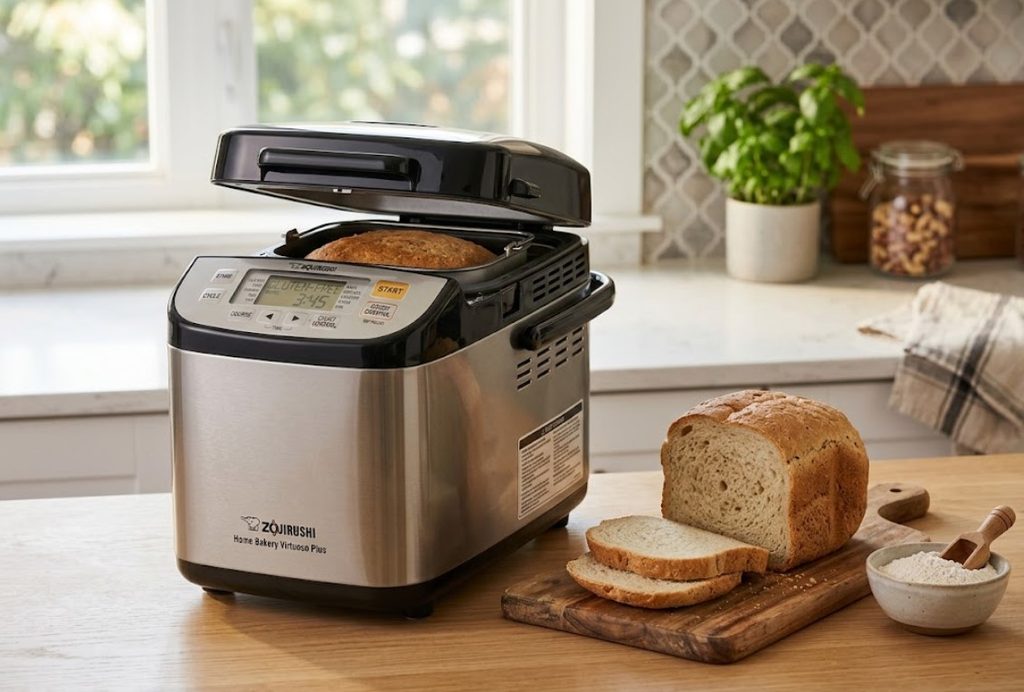
1. Zojirushi Home Bakery Virtuoso Plus BB-PDC20 — Best Overall
The Zojirushi Home Bakery Virtuoso Plus BB-PDC20 is our top choice for people who regularly make gluten-free bread and want a premium machine capable of handling many other recipes as well.
The BB-PDC20 makes a traditional-shaped 2-pound loaf and includes a dedicated Gluten Free course. It also offers Multigrain, Whole Wheat, Vegan, Sugar Free, Salt Free, Sourdough Starter, Cake, Jam, and other programs. Zojirushi lists 15 menu settings in total.
One of its biggest strengths is the combination of dual kneading blades and an additional heater in the lid. This design helps distribute mixing and heat more evenly across the loaf. For gluten-free bread, where uneven mixing or baking can produce disappointing texture, that can be particularly useful.
The machine also offers three Homemade memory settings, allowing experienced users to customize kneading, rising, and baking times. Its 13-hour delay timer is useful if you want fresh bread ready around breakfast or another planned time.
Pros
- Dedicated gluten-free course
- Dual kneading blades
- Additional lid heater
- 2-pound loaf capacity
- Multiple specialty programs
- Custom Homemade settings
- 13-hour delay timer
Cons
- Premium price
- Large countertop footprint
- More machine than occasional bakers may need
Best for: Regular gluten-free bread bakers who prioritize consistency, capacity and premium features.
2. Panasonic SD-R2550 — Best for Gluten-Free Variety
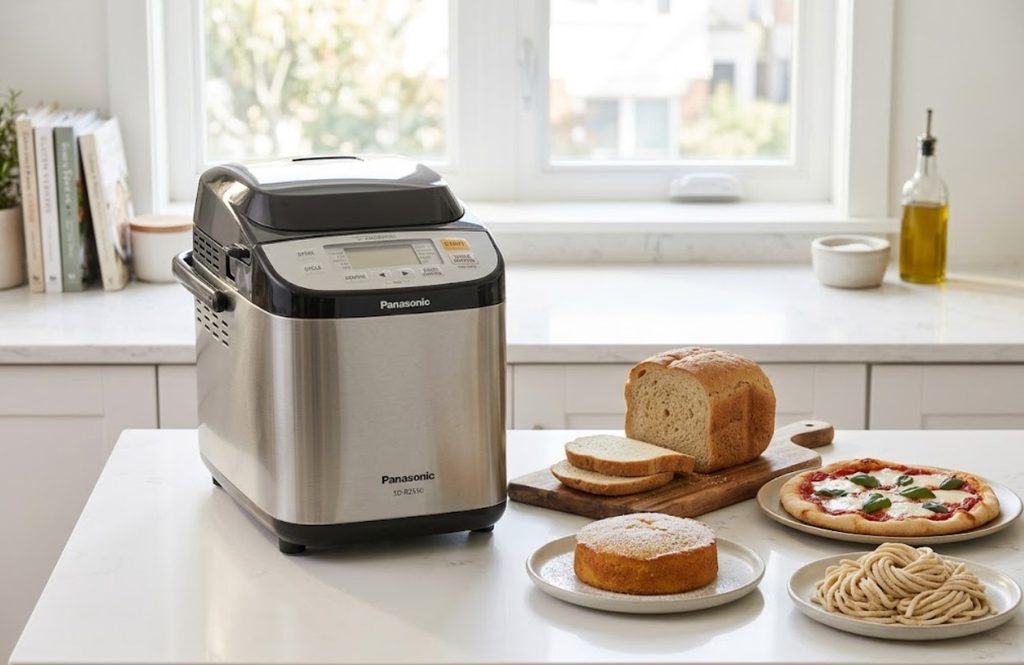
The Panasonic SD-R2550 is particularly interesting for gluten-free households because Panasonic provides multiple dedicated gluten-free programs rather than treating gluten-free baking as a single option.
The manufacturer’s information lists four gluten-free programs covering bread, cake, pizza dough, and pasta. It also features dual temperature sensors, a raisin/nut dispenser, manual kneading and fermentation settings, three loaf sizes, and a 13-hour timer.
That variety makes this machine more versatile than a bread maker that only provides a basic gluten-free bread cycle. If your household regularly experiments with gluten-free pizza dough, cakes, pasta, and bread, having dedicated programs for different foods can be a major advantage.
Panasonic also emphasizes temperature sensing and automatic adjustment of the rising and resting process. This can be helpful because gluten-free baking often requires more careful control than standard wheat bread.
Pros
- Four gluten-free programs
- Temperature sensors
- Automatic ingredient dispenser
- Manual kneading and fermentation settings
- Three loaf sizes
- 13-hour timer
- Broad recipe flexibility
Cons
- Larger footprint than some compact models
- Program availability can vary by regional version
- More expensive than basic bread makers
Best for: Families that want one machine for gluten-free bread plus pizza dough, cake and other specialty recipes.
3. Breville Custom Loaf BBM800XL — Best for Customization
The Breville Custom Loaf BBM800XL is a strong choice for bakers who want more control rather than simply pressing a preset button.
Breville’s instruction material includes a dedicated Gluten Free setting and specific guidance for gluten-free recipes. Its instructions explain that gluten-free mixtures may resemble a thick batter and provide a dedicated process for preparing them.
The biggest attraction of the Custom Loaf is flexibility. Instead of being limited to a fixed set of programs, the machine is designed for people who want to adjust the bread-making process. This can be particularly useful when you have a gluten-free recipe that does not behave exactly like the recipe supplied with the machine.
Gluten-free baking often involves experimentation with different flour blends, hydration levels, and binders. A customizable bread maker gives experienced bakers more room to adjust their process as they learn what works best.
Pros
- Dedicated gluten-free setting
- Strong customization options
- Useful for experimental recipes
- Large capacity
- Good choice for experienced home bakers
Cons
- Learning curve
- Larger than compact machines
- Premium pricing
Best for: Experienced gluten-free bakers who want to fine-tune recipes rather than rely entirely on automatic programs.

4. KBS 17-in-1 Bread Maker — Best Mid-Range Value
The KBS 17-in-1 bread maker is worth considering if you want a large selection of automatic programs without immediately moving into premium-brand pricing.
The model is commonly listed with multiple bread and specialty programs, including gluten-free options. It is designed around a 2-pound maximum loaf size and offers a broad range of functions beyond basic bread baking.
This type of machine can be appealing for households that want to experiment. Instead of purchasing a bread maker only for gluten-free loaves, you can use it for conventional bread, dough, cakes, jams, and other preparations depending on the exact model and regional version.
One important consideration is that program names and specifications can differ among KBS versions. Before purchasing, verify the exact model number and confirm that the specific machine you are considering includes a dedicated gluten-free program.
Pros
- Large selection of programs
- Up to 2-pound capacity
- Versatile for different recipes
- Often competitively priced
- Good option for experimenting
Cons
- Model variations can be confusing
- Brand support may vary by market
- More programs do not automatically mean better gluten-free results
Best for: Buyers who want a feature-rich bread maker without paying premium-brand prices.

5. Cuisinart CBK-200 Convection Bread Maker — Best for Even Baking
The Cuisinart CBK-200 Convection Bread Maker is an option for people who are interested in convection-assisted baking and a straightforward interface.
The model is associated with a gluten-free program and offers a 2-pound bread capacity. Its convection design circulates hot air during baking, which can help with browning and overall heat distribution.
That can be attractive when working with gluten-free recipes because the texture and structure of gluten-free bread can make even baking more challenging. However, results will still depend heavily on the specific recipe, flour blend, hydration and program.
When shopping for this model, pay close attention to the exact model and seller listing because Cuisinart has released multiple bread-maker models over time. For example, Cuisinart’s current website identifies the older CBK-110 as discontinued, so buyers should not assume that every similarly named Cuisinart bread maker is a current model.
Pros
- Convection baking
- Gluten-free program
- 2-pound capacity
- Multiple bread settings
- Useful for general bread baking
Cons
- Model availability can vary
- Larger footprint
- Not the newest option in every market
Best for: Bakers who specifically want convection-assisted baking and can verify the availability of the correct model.

6. Hamilton Beach HomeBaker 29885 — Best Budget Pick
If you want a more affordable way to start making gluten-free bread at home, the Hamilton Beach HomeBaker 29885 is worth investigating.
This model has commonly been sold with a dedicated gluten-free cycle and a 2-pound capacity. It focuses more on straightforward everyday baking than premium customization, making it attractive for beginners who do not need dozens of advanced controls.
The biggest reason to consider a budget machine is not simply the lower purchase price. It is the ability to determine whether homemade gluten-free bread fits your routine before investing in a premium bread maker.
However, check the exact model and current retailer listing before buying. Hamilton Beach has sold several bread maker models, and availability and specifications can change over time.
Pros
- Affordable starting point
- Gluten-free setting
- 2-pound capacity
- Straightforward operation
- Suitable for beginners
Cons
- Fewer premium features
- Less customization than high-end models
- Build and finish may not match premium machines
Best for: Beginners who want to try gluten-free bread making without making a large initial investment.

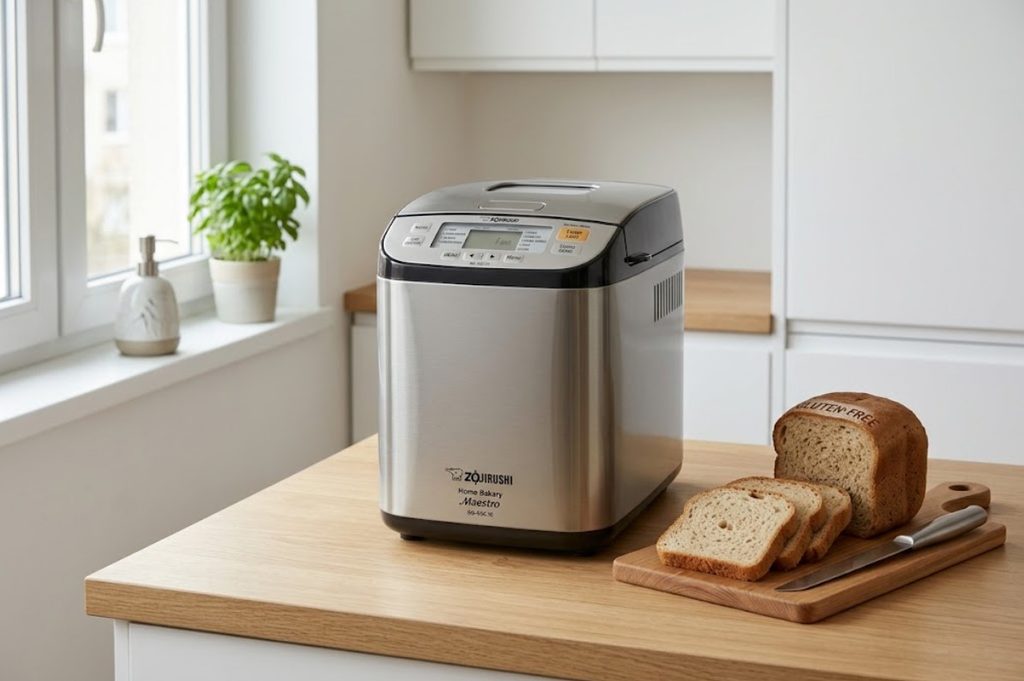
7. Zojirushi Home Bakery Maestro BB-SSC10 — Best Compact Premium Pick
The Zojirushi Home Bakery Maestro BB-SSC10 is the model to consider when you want premium gluten-free features but do not need a 2-pound loaf.
Zojirushi confirms that the BB-SSC10 includes a designated gluten-free course. Its course list also includes white, European, whole wheat, multigrain, vegan, cake, jam, dough, and Homemade options.
The smaller capacity makes it especially interesting for individuals, couples, or households that do not need large loaves. It can also make sense for people who have limited counter space but still want a more advanced bread maker.
If kitchen space is one of your main concerns, you may also want to compare this model with other space-saving machines after reading Best Compact Bread Makers for Small Kitchens: 7 Space-Saving Picks.
Pros
- Dedicated gluten-free course
- Compact 1-pound capacity
- Premium construction
- Multiple specialty programs
- Useful for smaller households
Cons
- Smaller loaf size
- Premium price
- Not ideal for large families
Best for: Small households that want a premium gluten-free bread maker without the capacity and size of a full 2-pound machine.
How to Choose the Best Bread Maker for Gluten-Free Bread
Look for a real gluten-free cycle
Do not assume that every bread maker can produce good gluten-free bread simply because you can manually change its settings. A dedicated program is generally a much easier starting point.
Manufacturers design these programs around different ingredient behavior. Panasonic, for example, specifically provides separate gluten-free programs for bread, cake, pizza dough and pasta on its SD-R2550.
Consider loaf size
A 1-pound machine can be ideal for one or two people, while a 2-pound machine makes more sense for families.
A larger loaf does not automatically mean better gluten-free bread. If you frequently throw away leftovers because the loaf becomes stale before you can finish it, a smaller machine may actually be more practical.
Pay attention to heat distribution
Even heating is important for gluten-free bread because the structure can be more delicate. Premium models with additional heaters or sophisticated temperature controls can be attractive if you bake frequently.
The Zojirushi BB-PDC20, for example, uses an additional heater in the lid, while Panasonic’s SD-R2550 uses dual temperature sensors.
Think about your other recipes
Do you want only gluten-free bread, or do you also want pizza dough, cakes, jams, sourdough starters, or conventional bread?
A machine with several useful programs may provide better long-term value than a cheaper machine that you only use occasionally.
Check the pan and paddle
Gluten-free mixtures can stick more easily than conventional dough. A good non-stick pan and removable paddle can make cleanup considerably easier.
Also inspect whether replacement pans and paddles are available in your market before purchasing an expensive bread maker.
Consider your kitchen space
Bread makers are countertop appliances, and their footprint can be larger than expected. Measure the space where you plan to keep the machine before ordering.
If you are choosing between appliances for a limited countertop, your decision may also depend on what else you bake. Our comparison Bread Maker vs. Stand Mixer: 7 Key Differences and Which One Should You Buy? explains how these two appliances differ in convenience, versatility, dough preparation, and countertop use.
Tips for Better Gluten-Free Bread in a Bread Maker
Even the best bread maker cannot compensate for inaccurate ingredients or a recipe that does not suit the machine.
Use a reliable gluten-free flour blend
Different gluten-free flours absorb water differently. A recipe developed for one flour blend may not work exactly the same way with another.
Measure accurately
A digital kitchen scale is often more reliable than measuring cups, especially when working with flour blends and starches.
Follow the machine’s ingredient order
Bread makers are designed around a particular ingredient-loading sequence. Follow the manufacturer’s recipe instructions rather than automatically using the same order you would use when mixing bread by hand.
Avoid opening the lid repeatedly
Once the machine enters the rising or baking stage, unnecessary lid opening can affect temperature and the final structure.
Let the loaf cool properly
Gluten-free bread can be fragile when it is hot. Allowing it to cool before slicing can help the crumb set and reduce crumbling.
Prevent cross-contact
If you are making bread for someone with celiac disease or a medically necessary gluten-free diet, the ingredients are only part of the equation. Clean utensils, storage containers, work surfaces, and other kitchen equipment should also be considered to reduce cross-contact.
Bread Maker vs. Oven for Gluten-Free Bread
A bread maker is not automatically better than an oven. The major advantage is convenience. A bread maker can mix and bake the loaf in one appliance, while an oven gives you greater control over shape, baking vessels, crust and recipe technique.
For people who enjoy experimenting with gluten-free recipes, an oven can eventually offer more flexibility. For people who want a relatively hands-off process, a bread maker can be much easier.
If you are deciding between these approaches, Bread Maker vs. Oven: 7 Key Differences and Which Is Better? provides a broader comparison of convenience, control, baking, cleanup, and versatility.
Is a Gluten-Free Bread Maker Worth It?
For people who eat gluten-free bread regularly, a bread maker can be a worthwhile investment because it can reduce the hands-on work involved in preparing homemade bread.
The value becomes stronger when you choose a model with a dedicated gluten-free course that matches your needs. However, buying the most expensive machine is not necessary for everyone. A beginner may be better served by an affordable model, while a frequent baker may benefit from better temperature control, multiple programs, dual paddles or custom cycle settings.
For people who are new to bread machines, Best Bread Makers for Beginners: 7 Easy-to-Use Picks for Homemade Bread can help explain the basic features to consider before moving into specialized gluten-free models.
And if you are building a wider kitchen-appliance setup on a budget, Best Blenders Under $100: 7 Affordable Picks for Smoothies, Food Prep & More is another useful budget-focused guide from KitchenNestPro.
Frequently Asked Questions
Can any bread maker make gluten-free bread?
Not necessarily. Some machines can make gluten-free bread using manual settings, but a dedicated gluten-free program is generally a better starting point because it is designed around the different structure and timing of gluten-free mixtures.
What is the best bread maker for gluten-free bread?
For overall performance and premium features, the Zojirushi BB-PDC20 is our top pick. It has a dedicated gluten-free course, dual kneading blades, a lid heater and a 2-pound capacity.
Is a 1-pound bread maker enough?
Yes. A 1-pound machine can be a good choice for individuals or couples who prefer smaller, fresher loaves. The Zojirushi BB-SSC10 is an example of a premium machine designed around a smaller loaf size.
Does gluten-free bread need a special cycle?
Usually, yes. Gluten-free mixtures behave differently from wheat-based dough, so a cycle designed specifically for gluten-free recipes can make the process easier and more consistent.
Can I use my own gluten-free flour blend?
Usually, but results can vary. Different blends contain different combinations of flours, starches, and binders. Follow the bread maker’s recommended recipes first and experiment gradually.
Can I use a bread maker for gluten-free pizza dough?
Some models provide dedicated gluten-free pizza-dough programs. Panasonic’s SD-R2550, for example, includes gluten-free programs for bread, cake, pizza dough and pasta.
Do I need a premium bread maker for gluten-free baking?
No. Premium machines can provide additional control and convenience, but an affordable machine with a genuine gluten-free program may be enough for someone who is just starting.
Final Verdict
The Zojirushi Home Bakery Virtuoso Plus BB-PDC20 is our best overall choice for gluten-free bread because it combines a dedicated gluten-free course with dual kneading blades, an additional lid heater, a 2-pound capacity, and several specialty programs. The Panasonic SD-R2550 is especially appealing if you want several dedicated gluten-free options, while the Breville Custom Loaf BBM800XL is better suited to experienced bakers who want greater control over the process.
For a more affordable starting point, the Hamilton Beach HomeBaker 29885 is worth considering if you can verify the exact model and its current gluten-free program. Meanwhile, the Zojirushi BB-SSC10 stands out for smaller households that want premium features without moving to a full 2-pound machine. Whichever model you choose, remember that the bread maker is only one part of the result: the flour blend, recipe, ingredient measurements, baking cycle and careful handling all play major roles in producing good gluten-free bread.
For Detail Information visit the below links:
Zojirushi BB-PDC20 — Best Overall
Official Zojirushi BB-PDC20 product page
Use this in the Zojirushi section to support its 2-lb capacity, gluten-free course, programs, and specifications. Panasonic SD-R2550 — Best for Gluten-Free Variety
Official Panasonic SD-R2550 product page
This supports its gluten-free baking capability, 20 programs, temperature sensors, loaf sizes and other features. Zojirushi Gluten-Free FAQ
Zojirushi Breadmaker Gluten-Free FAQ
This is especially useful because Zojirushi explicitly confirms that the BB-PDC20 and BB-SSC10 have designated gluten-free courses and recipes. Panasonic Gluten-Free Manual
Panasonic Bread Maker Gluten-Free Instructions
Good for your gluten-free baking tips section because Panasonic provides specific instructions and notes about gluten-free mixes and yeast.