

Introduction
Making homemade bread can be as simple as adding ingredients to a machine and pressing a button, or it can be a hands-on process involving kneading, proofing, shaping, scoring, and baking in a conventional oven. Both methods can produce delicious bread, but they offer very different experiences. A bread maker focuses on convenience and automation, while an oven gives you greater control over the shape, crust, texture and overall baking process.
So, which is better: a bread maker or an oven? The answer depends on what you value most. If you want fresh bread with minimal effort and consistent results, a bread maker can be an excellent choice. If you enjoy experimenting with recipes, shaping artisan loaves, and controlling every stage of baking, an oven may be the better option. In this guide, we’ll compare a bread maker vs. oven across 7 important differences so you can decide which method fits your kitchen, schedule, budget and baking style.
Bread Maker vs. Oven at a Glance
Before looking at each difference in detail, here’s a quick comparison:
| Feature | Bread Maker | Conventional Oven |
| Ease of use | Excellent | Requires more work |
| Kneading | Automatic | Manual or mixer required |
| Proofing | Usually automatic | Manually controlled |
| Baking | Automatic | Manual |
| Crust control | Limited to settings | Excellent |
| Loaf shape | Usually fixed | Almost unlimited |
| Recipe flexibility | Moderate | Excellent |
| Consistency | Very good | Depends on skill |
| Artisan bread | Limited | Excellent |
| Hands-on effort | Low | Medium to high |
| Convenience | Excellent | Moderate |
| Best for | Everyday bread | Creative and artisan baking |
Now let’s look at the 7 key differences in detail.
1. Convenience and Ease of Use
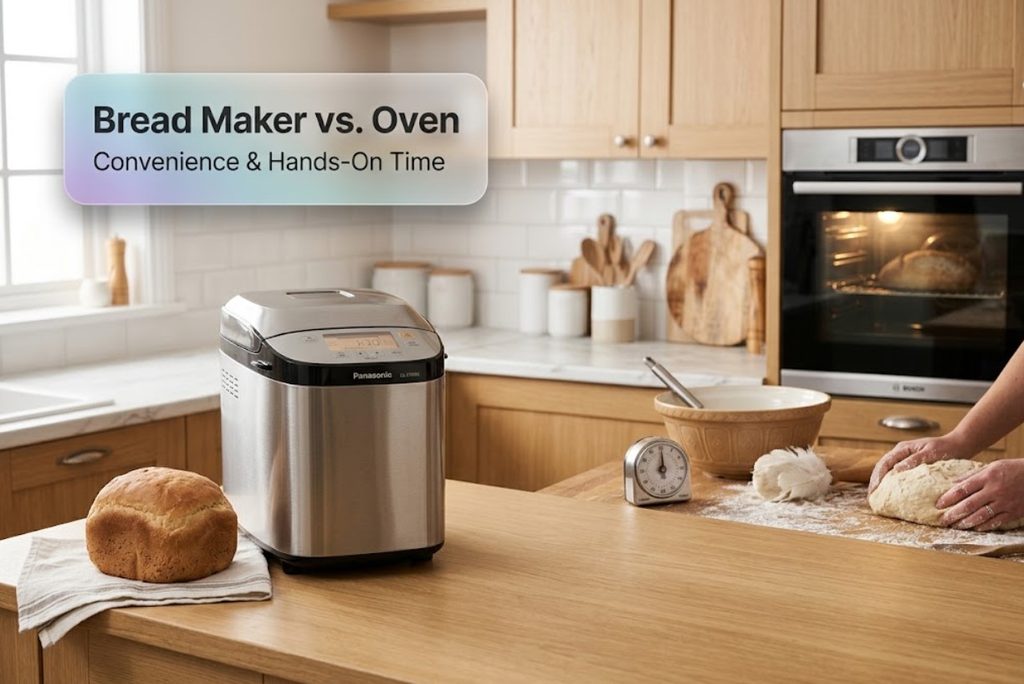
The biggest difference between a bread maker and an oven is how much work you have to do yourself.
A bread maker is designed to automate most of the bread-making process. Depending on the model and program, you normally add ingredients to the bread pan, select the desired setting, and allow the machine to handle mixing, kneading, rising and baking. Many machines also offer delay timers, crust settings and specialized programs.
This makes a bread maker particularly attractive for beginners and busy households. You don’t need to stand beside the machine while the dough is being kneaded or constantly check whether the dough has risen enough.
A conventional oven works differently. The oven mainly handles the final baking stage. Before the bread goes into the oven, you normally have to mix the ingredients, knead the dough, allow it to rise, shape it and prepare it for baking. You can perform these tasks by hand or use another appliance, such as a stand mixer with a dough hook.
That extra involvement isn’t necessarily a disadvantage. Many people actually enjoy the process of making bread. Working with dough allows you to feel its texture, observe fermentation and make adjustments along the way.
However, if your main goal is fresh homemade bread without spending much time actively preparing it, the bread maker has a clear advantage. Bread machines are particularly useful for people who want to start a loaf and continue with other activities rather than monitor every stage.

2. Time and Hands-On Effort
It is easy to assume that a bread maker always makes bread significantly faster than an oven, but the reality is more complicated.
A bread maker can save a considerable amount of active effort because it handles kneading and other stages automatically. You can load the ingredients, choose a program and leave the machine to work.
However, the complete bread-making cycle may still take several hours. Some bread-maker programs can take around three to five hours depending on the recipe and machine. Traditional oven baking can also take several hours when mixing, proofing, shaping and baking are included.
The major advantage of the bread maker is therefore not necessarily the total clock time. It is the amount of hands-on time required.
For example, imagine you want fresh bread for breakfast. With a bread maker that has a delay timer, you may be able to add the ingredients before going to bed and program the machine to finish around breakfast time.
With an oven, you generally need to prepare the dough yourself before baking it. You have more opportunities to control the process, but you also have more responsibilities.
For people with busy schedules, this difference can be extremely important.
If you enjoy spending a Saturday afternoon preparing dough, experimenting with fermentation, and shaping bread, the additional effort may actually be part of the experience. But if you simply want reliable bread for sandwiches, toast or breakfast, automation can be much more valuable.
3. Crust, Texture and Overall Bread Quality
When comparing a bread maker vs. oven, bread quality is one of the most important differences.
A bread maker can produce soft, evenly baked bread that works extremely well for everyday uses such as sandwiches and toast. Many machines allow you to choose different crust colors, such as light, medium, or dark.
However, a conventional oven provides much greater control over the final crust.
Oven baking makes it easier to achieve a deeply browned, crisp, chewy crust. Techniques such as steam baking, using a Dutch oven, baking stones, or different oven temperatures can significantly change the finished loaf.
The oven also provides greater control over crumb structure. You can experiment with hydration, fermentation time, kneading methods, shaping and proofing to create different textures.
A bread maker generally follows a predetermined program. This consistency is useful, especially for beginners, but it can also limit experimentation.
This doesn’t mean that bread made in a bread maker is poor quality. In fact, a good machine can produce excellent everyday bread. The important difference is control.
If you want a soft sandwich loaf that comes out consistently, the bread maker may be ideal.
If you want a crusty artisan loaf with a chewy exterior and an open crumb, the oven usually provides more possibilities.

4. Loaf Shape and Size
Another major difference is the shape of the finished bread.
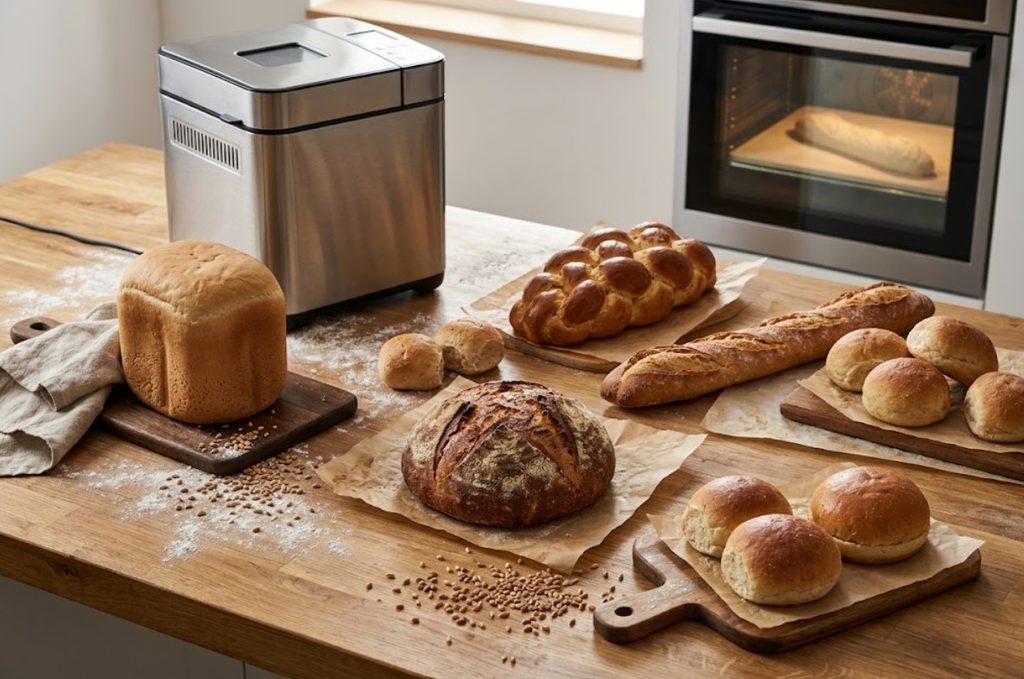
Bread makers use a dedicated bread pan, so you’re generally limited to the shape of that pan. Many bread machines produce tall or rectangular loaves that are practical for slicing and sandwiches.
This shape is convenient, but it isn’t suitable for every type of bread.
With an oven, you can choose almost any shape you want.
You can make:
- Round artisan loaves
- Baguettes
- Long French-style bread
- Dinner rolls
- Hamburger buns
- Braided bread
- Pull-apart bread
- Small individual loaves
- Large rustic loaves
This flexibility is one of the strongest reasons experienced bakers prefer ovens.
The oven also gives you greater control over loaf size. Instead of being restricted to the capacity of a bread machine pan, you can divide dough into different portions or make multiple loaves.
Bread machines can also have limitations concerning loaf sizes, although some models offer several size options.
For a family that mainly wants sliced sandwich bread, the fixed shape of a bread maker may not be a problem at all.
But if you dream of making a beautiful round sourdough boule or a long baguette, an oven is the more flexible choice.
5. Recipe Flexibility and Creativity
If you love experimenting in the kitchen, the oven has another major advantage.
A conventional oven doesn’t care what recipe you’re following. As long as your dough and baking process are suitable for the oven, you can experiment with different ingredients, shapes, sizes, fermentation methods and baking temperatures.
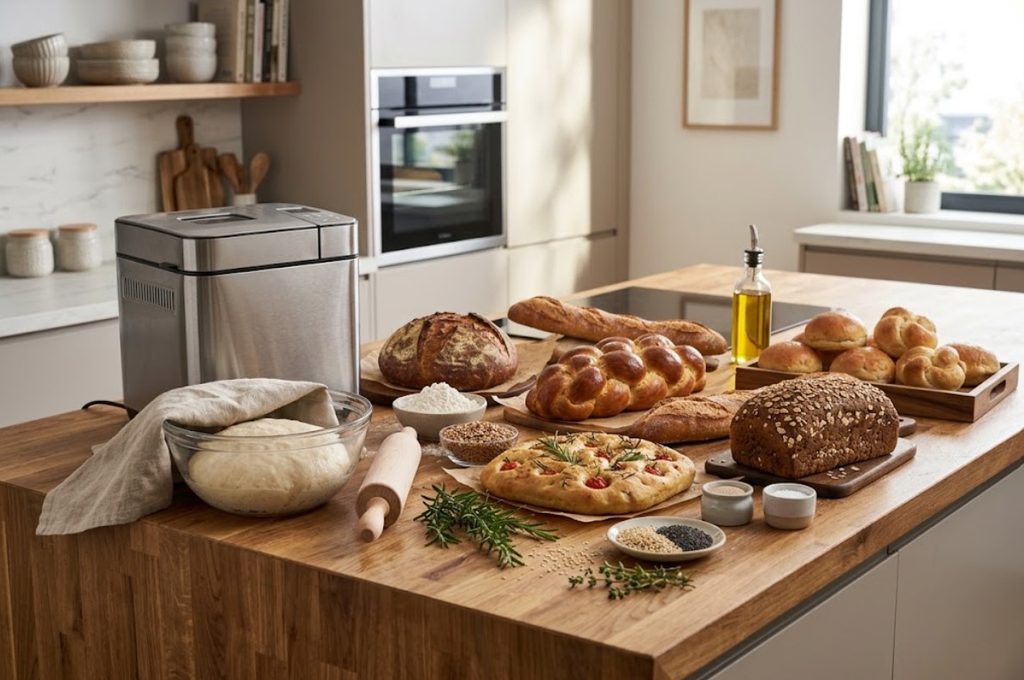
You can try:
- Sourdough
- Baguettes
- Ciabatta
- Focaccia
- Whole-grain bread
- Rye bread
- Seeded bread
- Garlic bread
- Herb bread
- Sweet breads
- Dinner rolls
A bread maker can also make more than basic white bread. Many modern models offer programs for whole wheat, sweet bread, gluten-free recipes, dough, cakes, jam, and other preparations. Some machines can also knead and proof dough that you later remove and bake in the oven.
However, you’re still working within the machine’s capacity and available programs.
This is where a hybrid approach becomes interesting.
You can use the bread maker to mix, knead, and proof the dough, then remove the dough, shape it yourself, and bake it in your oven.
This gives you much of the convenience of a bread machine while retaining the shaping and crust advantages of oven baking.
If you’re still learning what a bread maker can actually do, What Is a Bread Maker? Types, Uses, Benefits & Complete Buying Guide (2026) can give readers a broader understanding of bread-maker functions before deciding which method is right for them.
6. Skill Level and Consistency
Your baking experience can strongly influence whether a bread maker or oven is better for you.
For beginners, a bread maker can reduce many of the difficulties involved in bread making. The machine follows a programmed sequence, which means you don’t have to learn every stage immediately.
Once you understand the correct ingredient measurements and follow the machine’s recommended recipes, you can achieve reasonably consistent results.
This is particularly helpful if you’ve tried making bread manually and ended up with problems such as:
- Dense bread
- Poorly risen dough
- Uneven baking
- Over-proofing
- Under-proofing
- Burnt crust
- Raw centers
An oven, on the other hand, gives you more control but also gives you more opportunities to make mistakes.
You need to understand dough consistency, fermentation, proofing, oven temperature, baking time and shaping.
The benefit is that these skills improve with practice.
Once you become comfortable with oven baking, you can make adjustments that a bread maker may not allow. You can change hydration, fermentation time, shaping, temperature and baking technique according to the recipe.
Therefore, the bread maker is usually better for easy and repeatable results, while the oven is better for skill development and experimentation.
If you’re a beginner considering a machine specifically because you want a simple starting point, you can also explore Best Bread Makers for Beginners: 7 Easy-to-Use Picks for Homemade Bread before choosing a model.

7. Cost, Energy Use and Kitchen Space
The final major difference involves money and kitchen space.
If you already own a conventional oven, you don’t need to purchase another appliance specifically for baking bread. You may need basic equipment such as mixing bowls, measuring tools, baking trays or a mixer, depending on the recipes you make.
A bread maker requires an additional upfront purchase.
The cost varies considerably depending on the model, features, capacity, and brand. Basic machines can be relatively affordable, while premium models with advanced programs and automatic ingredient dispensers can cost considerably more.
Energy use also depends on how you bake.
For a single loaf, a bread maker’s smaller enclosed baking chamber can potentially be more efficient than heating a large conventional oven. However, this isn’t a universal rule because energy consumption depends on the appliance, cycle length, temperature and how much you bake at once.
If you are already using your oven to prepare dinner, baking bread at the same time may make better use of the oven’s energy.
Kitchen space is another factor that is easy to overlook.
A bread maker needs a permanent or temporary place on your countertop or in storage. If your kitchen is small, adding another appliance may become inconvenient.
Before buying one, consider how frequently you’ll actually use it.
If you bake bread several times a week, the convenience may easily justify the space.
If you only bake bread occasionally, your existing oven may be the more practical choice.

Bread Maker vs. Oven: Which Is Better for Different Types of Bakers?
There isn’t one universal winner. The better choice depends on how you plan to make bread.
Choose a Bread Maker If You:
- Are new to bread making
- Have a busy schedule
- Want minimal hands-on work
- Prefer consistent results
- Mostly make sandwich bread
- Want automatic kneading and proofing
- Like delay timers
- Don’t want to spend much time cleaning several pieces of equipment
- Have difficulty kneading dough manually
- Want to make bread regularly with minimal effort
A bread maker is particularly useful when convenience matters more than having complete control over the baking process.
Choose an Oven If You:
- Enjoy baking from scratch
- Want maximum control
- Prefer crispy crusts
- Like artisan-style bread
- Want different loaf shapes
- Make baguettes or sourdough
- Enjoy experimenting with recipes
- Want to control fermentation and proofing
- Already own a good oven
- Don’t mind spending more time preparing dough
The oven becomes especially attractive once you start viewing bread making as a hobby rather than simply a way to produce a loaf.
What About Using Both?
You don’t necessarily have to choose one.
One of the smartest options for many home bakers is to use a bread maker and oven together.
The bread maker can handle:
- Mixing
- Kneading
- Initial proofing
You can then remove the dough, shape it manually, and transfer it to your oven for the final bake.
This approach combines the convenience of a bread machine with the flexibility of an oven.
For example, you could use your bread maker’s dough setting to prepare pizza dough, focaccia dough, dinner rolls, or an artisan bread dough. Once the machine finishes its work, you can shape the dough and use your oven to achieve the desired crust and appearance.
This hybrid method is especially useful for people who like homemade bread but don’t want to knead dough manually every time.
It also gives you an opportunity to develop your baking skills gradually.
Bread Maker vs. Oven: Pros and Cons
Bread Maker Pros
- Very convenient
- Minimal hands-on work
- Automatic kneading
- Automatic proofing on many programs
- Consistent results
- Useful for beginners
- Some models include delay timers
- Can offer multiple bread programs
- Some can make dough, cakes, or jam
- Requires less active attention
Bread Maker Cons
- Fixed loaf shape
- Limited control over the baking process
- Less suitable for some artisan breads
- Takes up additional counter or storage space
- Some loaves have a hole where the kneading paddle sits
- You are generally limited by the machine’s capacity
- Buying another appliance adds to your kitchen costs
Oven Pros
- Excellent control over baking
- Greater recipe flexibility
- Better for artisan bread
- Unlimited shaping possibilities
- Better control over crust
- Suitable for different loaf sizes
- Can bake multiple types of bread
- You probably already own one
Oven Cons
- More hands-on work
- Requires more baking knowledge
- Kneading and proofing usually need to be handled separately
- Results can vary with technique
- More opportunities for mistakes
- May require additional baking equipment
Which One Should You Choose?
The answer ultimately comes down to your priorities.
If your priority is convenience, choose a bread maker.
If your priority is control, choose an oven.
If your priority is consistent everyday bread, a bread maker is an excellent option.
If your priority is artisan bread, unusual shapes, crispy crusts and experimentation, an oven is generally the better choice.
And if you want both convenience and flexibility, don’t overlook the hybrid method: let the bread maker prepare the dough and use your oven for the final bake.
For readers who are completely new to bread makers, Best Bread Makers for Beginners: 7 Easy-to-Use Picks for Homemade Bread is a useful next step for comparing beginner-friendly machines.

Frequently Asked Questions
Is bread from a bread maker as good as oven-baked bread?
Yes, a bread maker can produce very good bread, especially soft sandwich-style loaves. However, an oven generally gives you greater control over crust, shape, and texture. The final quality also depends on the recipe, ingredients, equipment and your baking skill.
Is a bread maker easier than an oven?
Yes. A bread maker is generally easier because it can automate mixing, kneading, proofing and baking. With an oven, most of the preparation needs to be handled separately.
Does a bread maker save time?
A bread maker mainly saves active preparation time, rather than necessarily reducing the total time required to make bread. Some complete bread-machine cycles can still take several hours.
Can I use a bread maker and then bake the bread in an oven?
Yes. Many bread makers have a dough-only setting. You can allow the machine to mix, knead, and proof the dough, then remove it, shape it and bake it in your oven.
Which is better for beginners?
A bread maker is usually easier for beginners because it automates many of the more difficult stages. Once you become comfortable with bread making, you can experiment with oven baking for greater control.
Which is better for crispy bread?
A conventional oven generally has the advantage because you have greater control over temperature, steam, baking surfaces and crust development.
Is a bread maker worth buying if I already have an oven?
It can be, especially if you bake frequently and value convenience. If you only make bread occasionally or enjoy traditional baking, your existing oven may already be enough.
Final Verdict: Bread Maker vs. Oven
There is no single winner in the bread maker vs. oven debate because each method is designed for a different type of baker. A bread maker is the better choice for convenience, consistency, automation, and everyday sandwich-style bread. It can make homemade bread much more approachable for beginners and busy households. An oven, meanwhile, is the better choice for people who want control over shape, crust, texture, fermentation, and recipe creativity. Oven baking also gives you the freedom to make everything from baguettes and rustic loaves to rolls and uniquely shaped breads.
For many home bakers, however, the smartest answer may be both. Use a bread maker when you want effortless everyday bread, and use your oven when you want to experiment or create an artisan-style loaf. The best method isn’t necessarily the one that produces the theoretically “perfect” bread—it’s the one that fits your routine well enough that you will actually keep making homemade bread.
For more detailed information about bread-making techniques and recipe ideas, readers can also explore trusted baking resources such as [a reputable baking authority or recipe resource].