

Introduction
A good coffee maker can become one of the most useful appliances in an office. Whether you are setting up a small home office, a shared workplace kitchen, or a larger break room, having fresh coffee available can make the workday more convenient. However, choosing an office coffee maker is different from choosing one for a typical home kitchen.
An office machine may need to serve several people throughout the day, handle repeated brewing, offer different cup sizes, be easy to operate and require minimal maintenance. In a larger workplace, speed and capacity can matter more than compactness. In a small office, however, a machine that takes up half the counter may be unnecessary.
The best choice therefore depends on the number of people using it, how frequently coffee is brewed, whether employees prefer individual cups or full carafes, and how much space is available.
If you are interested in understanding the difference between individual and batch brewing before choosing an office machine, our guide Drip Coffee Maker vs Single Serve Coffee Maker: Which Is Better? is a useful starting point.
In this guide, Best coffee makers for office use we look at seven coffee makers that suit different office situations, from commercial-style single-serve brewing to large-capacity drip machines and flexible brewers that can handle different preferences.
What Makes a Coffee Maker Good for an Office?
An office coffee maker has a different job from a machine used by one person at home. Instead of making one or two cups in the morning, it may be used repeatedly by different people throughout the day.
That makes several features particularly important.
Capacity
Capacity should be one of the first things you consider. A small office with three or four regular coffee drinkers may be perfectly comfortable with an 8- or 10-cup brewer. A larger workplace may benefit from a 12- or 14-cup machine or even a commercial single-serve system.
However, the number printed on a coffee maker does not always correspond to the number of standard mugs it fills because manufacturers generally use their own “cup” measurements. Think about your employees’ actual drinking habits rather than relying only on the cup number.
Brewing speed
Nobody wants a line of employees waiting around a coffee machine during a short morning break.
A fast brewer can be especially valuable when many people arrive at the office at approximately the same time. BUNN, for example, says its Speed Brew system can brew a full 10-cup carafe in about four minutes.
Ease of operation
An office machine should ideally be simple enough that someone can use it without reading a long manual.
Straightforward controls, clearly marked buttons, easy-to-fill reservoirs and simple brewing programs can make a big difference in a shared environment.
Cleaning
Cleaning becomes more important when several people use the same machine.
Removable filter baskets, accessible water reservoirs, dishwasher-safe components and simple descaling procedures can reduce the amount of maintenance required.
Durability
A home machine designed for occasional brewing may not be appropriate for a busy commercial environment.
Keurig specifically distinguishes between household and work brewers and recommends that offices use equipment with appropriate commercial ratings.
Before purchasing a machine for a workplace, check the manufacturer’s intended-use information rather than assuming that a popular home coffee maker is suitable for heavy office use.
7 Best Coffee Makers for Office Use
1. Keurig K155 OfficePRO — Best Single-Serve Office Pick
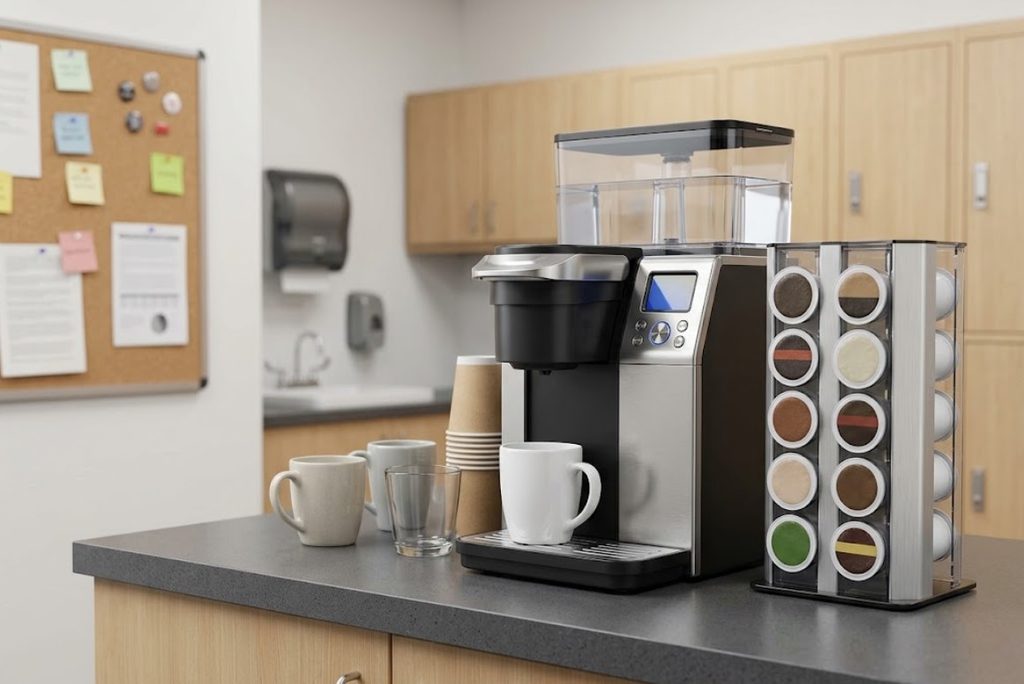
For offices where employees have different beverage preferences, the Keurig K155 OfficePRO is an attractive single-serve option.
Unlike a traditional drip machine that prepares one shared pot, a single-serve brewer allows each person to choose an individual pod and brew a cup when needed. This can be particularly convenient in workplaces where people arrive at different times and do not necessarily want the same coffee.
Keurig’s commercial information lists the K155 with a 90-ounce water reservoir, four brew sizes—4, 6, 8 and 10 ounces—and a full-color touchscreen. It is also NSF certified for foodservice and commercially UL listed.
The large reservoir means employees do not need to refill the machine after every few cups. That is a useful advantage in an office because constant refilling can quickly become irritating.
Another benefit is variety. Employees can choose different coffee, tea or other compatible beverages instead of relying on one pot of coffee.
The major disadvantage is the ongoing cost and waste associated with single-serve pods. For an office with heavy daily consumption, those costs can become significant.
It is also important to distinguish a commercial/work brewer from a household model. Keurig states that its work brewers are designed for commercial use, while many household models are intended only for home use.
Best for: Offices where employees want individual cups and beverage variety.
Main advantage: Convenient individual brewing with a large reservoir.
Potential drawback: Pod costs and waste can add up.
2. BUNN Speed Brew Classic Thermal — Best for Fast Full Pots
If an office needs a traditional carafe rather than individual pods, the BUNN Speed Brew Classic Thermal is an interesting option.
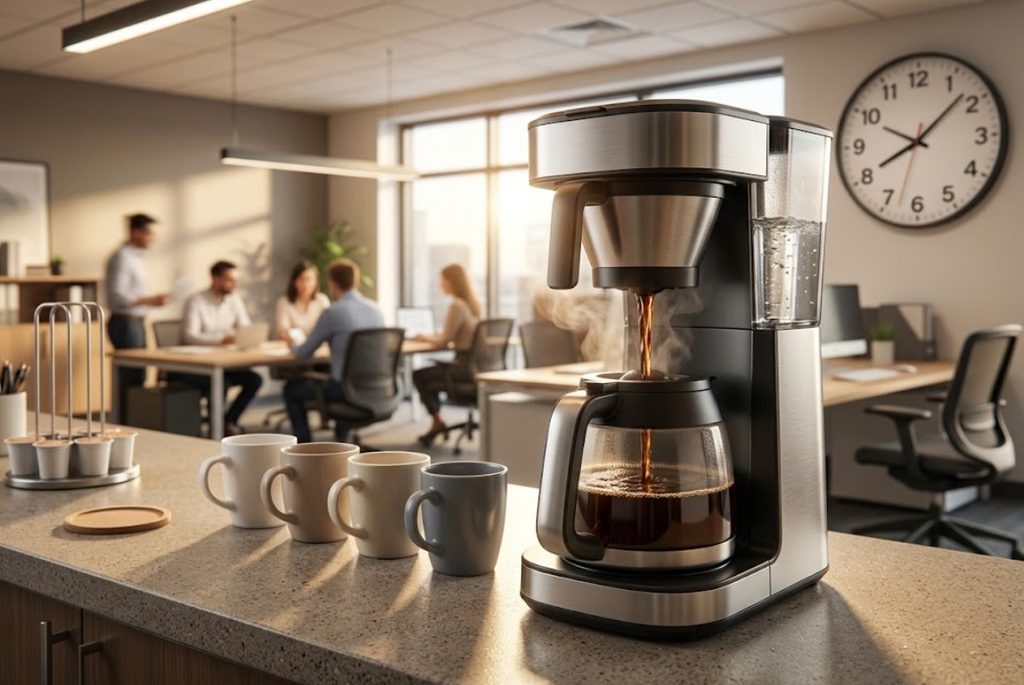
BUNN lists this model as a 10-cup thermal coffee maker and says its internal commercial-grade stainless-steel hot-water tank keeps 70 ounces of water hot and ready for brewing. The company states that the machine can brew a full 10-cup carafe in approximately four minutes.
That speed can be useful in a workplace where several people need coffee around the same time.
The thermal carafe is another office-friendly feature. Instead of keeping coffee on a hot plate, the double-wall insulated carafe is designed to maintain serving temperature for more than two hours, according to BUNN.
This makes the machine suitable for an office where employees may pour coffee at different times rather than sitting down together for one breakfast.
There is one important consideration: the internal hot-water tank keeps water hot continuously, so this type of brewer may not be ideal for every workplace or energy preference.
If your office regularly needs a full pot quickly, however, speed and thermal holding can make it a compelling option.
Best for: Offices that need full pots of coffee quickly.
Main advantage: Fast 10-cup brewing and thermal carafe.
Potential drawback: Its always-ready hot-water system may not suit every workplace.
3. Cuisinart 14-Cup Programmable Coffee Maker — Best for Large Teams
A larger office may benefit from a traditional high-capacity coffee maker such as the Cuisinart 14-Cup Programmable Coffee Maker.
Cuisinart’s current DCC-3200NAS model offers a 14-cup glass carafe, 24-hour programmability, regular and bold brew-strength control, a 1–4 cup setting, self-clean functionality, auto-off settings and Brew Pause. The listed dimensions are 7.75 inches long, 9 inches wide and 14 inches high.
The 14-cup capacity makes this type of machine particularly useful for larger teams. Instead of employees repeatedly starting small batches, the office can prepare a larger quantity at once.
Programmability is another advantage. If the office follows a predictable schedule, the machine can be programmed so coffee is ready around the beginning of the workday.
The 1–4 cup setting is useful when the office has fewer people present. This is a better situation than buying a large machine that can only sensibly be used for full batches.
The downside is its larger physical size compared with compact office machines. At 14 inches high, cabinet clearance should also be considered if the machine will sit beneath overhead cabinets.
For offices where coffee consumption is high, however, capacity can be more important than having the smallest possible machine.
Best for: Medium and larger offices with regular coffee consumption.
Main advantage: Large capacity and programmable brewing.
Potential drawback: Larger footprint and glass-carafe design.
If your office needs programmable brewing specifically, our related article Best Programmable Coffee Makers for Home: 7 Top Picks also explains which programmable features are actually worth prioritizing.

4. BLACK+DECKER 12-Cup Programmable Coffeemaker — Best Budget Office Option
For an office that needs a simple full-size coffee maker without spending heavily on advanced features, the BLACK+DECKER 12-Cup Programmable Coffeemaker is worth considering.
The current CM1160B-1 model has a 12-cup capacity, 24-hour auto-brew programming, Sneak-A-Cup technology, a 12-cup Duralife glass carafe and a washable brew basket. BLACK+DECKER lists its dimensions at 12.3 inches wide, 8.3 inches long and 11 inches high.
Its straightforward control system can be useful in an office because there is little learning involved.
Sneak-A-Cup is particularly practical when someone wants to pour a cup before the entire brewing cycle has finished.
The machine also has an auto-off function, which can be useful in a workplace where employees may forget to switch appliances off at the end of the day.
Its biggest strength is practicality. An office does not necessarily need a touchscreen, smart connectivity or complicated brewing customization.
For a small business trying to provide basic coffee without investing in a commercial beverage system, a simple programmable drip brewer can be a reasonable solution—provided its intended use and workload match the workplace.
Best for: Budget-conscious offices that want a conventional drip machine.
Main advantage: Large capacity and simple programmable operation.
Potential drawback: Glass carafe and fewer premium features.
5. Hamilton Beach FlexBrew Trio — Best for Mixed Preferences
One of the biggest challenges in a shared office is that employees do not always drink coffee the same way.
Some people want a full pot. Others want one cup. Some prefer pods, while others prefer ground coffee.
The Hamilton Beach FlexBrew Trio Coffee Maker is designed around this kind of flexibility.
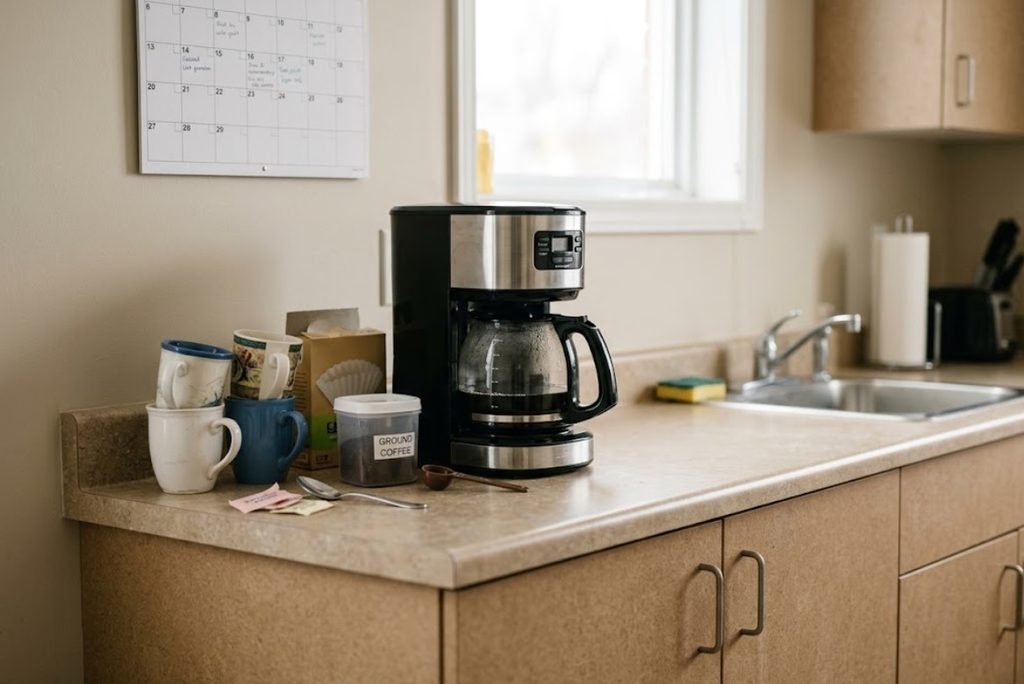
Hamilton Beach describes the model as offering three brewing methods: a full carafe, single-serve brewing with pods, and single-serve brewing with fresh grounds. The manufacturer lists a 12-cup glass carafe and a 40-ounce reservoir on the single-serve side. It also offers programmable brewing and different strength options.
The single-serve side can brew up to a 10-ounce pod-based cup or up to 14 ounces using grounds, according to Hamilton Beach.
This flexibility can be particularly useful in a small team where coffee preferences vary.
The drawback is that a multi-function machine can take more counter space and require more cleaning than a simple drip brewer.
Still, if your workplace needs both individual cups and full pots, combining those functions in one appliance may be more convenient than buying two separate machines.
Best for: Offices with employees who prefer different brewing methods.
Main advantage: Three brewing options in one machine.
Potential drawback: More components and a potentially larger countertop footprint.

6. OXO Brew 8-Cup Coffee Maker — Best Premium Drip Option
The OXO Brew 8-Cup Coffee Maker is a strong choice for a smaller professional team that wants a more premium brewing experience without moving to a very large machine.
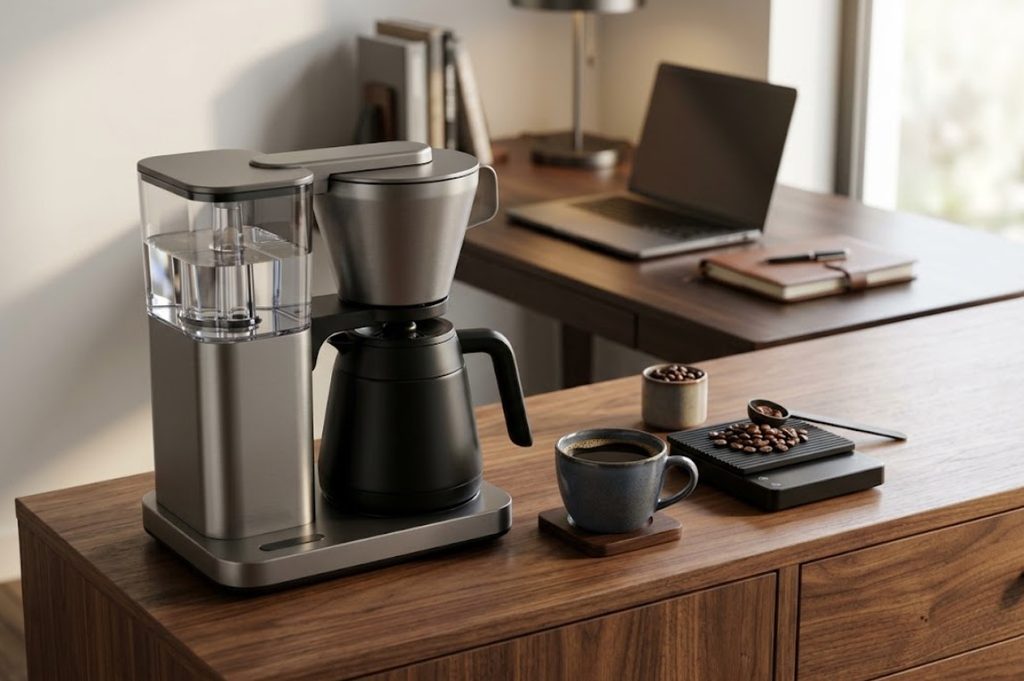
OXO’s 8-Cup model can brew either a single cup or a full carafe and uses a double-wall, vacuum-insulated thermal carafe. OXO also describes its brewer as meeting Specialty Coffee Association standards for home brewing.
An 8-cup machine can be a useful middle ground for an office. It provides more capacity than a single-serve machine but does not necessarily require the footprint of a large 12- or 14-cup system.
The thermal carafe is also useful in a workplace because people may drink coffee at different times. Coffee can be moved away from the machine instead of remaining on a hot plate.
If your office values coffee quality as much as convenience, a premium brewer can make sense.
However, it may be more machine than a workplace needs if the primary goal is simply inexpensive coffee for a large number of employees.
Best for: Small professional teams that value coffee quality and a thermal carafe.
Main advantage: Premium brewing with flexible serving size.
Potential drawback: Higher cost than basic office drip machines.
Our article Best Coffee Makers with Thermal Carafes: 7 Top Picks is also useful if maintaining coffee temperature without a warming plate is one of your office’s main priorities.
7. Keurig K-1550 Small Business Coffee Maker — Best for Small Businesses
For a workplace that wants a more purpose-built business coffee solution, the Keurig K-1550 is another option.
Keurig describes the K-1550 as a small-business coffee maker with four cup sizes—6, 8, 10 and 12 ounces—along with Brew Over Ice and a STRONG button. It has a 96-ounce water reservoir and Quiet Brew Technology designed to reduce noise during operation.
The large reservoir is particularly useful in a workplace because it reduces the frequency of refilling.
Noise can also matter more than people expect. A loud coffee machine operating repeatedly near desks or meeting rooms can become irritating, so quieter operation is a useful workplace consideration.
The K-1550 is designed for small business environments rather than being simply a household coffee maker placed in an office.
Keurig’s commercial lineup also includes larger business models for organizations with heavier beverage requirements.
The main disadvantage is that it is a commercial-style investment rather than a basic low-cost household coffee maker.
Best for: Small businesses wanting a dedicated office coffee solution.
Main advantage: Large reservoir, multiple cup sizes and business-oriented design.
Potential drawback: Higher investment than basic drip machines.

How Many Cups Does an Office Coffee Maker Need?
There is no universal answer because office coffee consumption varies considerably.
A two- or three-person home office may only need a compact 5- or 8-cup machine.
A workplace with 10 employees might benefit from a 10- or 12-cup brewer if most people drink coffee.
A larger team may be better served by a commercial single-serve system because employees can brew individual cups throughout the day without repeatedly preparing a shared pot.
A useful starting point is to estimate the number of cups actually consumed rather than the number of employees.
If 12 employees work in the office but only five drink coffee, you do not necessarily need a huge commercial system.
On the other hand, if coffee is offered during meetings, client visits and morning breaks, demand can rise quickly.
Drip vs. Single-Serve for an Office
A drip coffee maker is usually better when several people are happy drinking the same coffee.
It can produce a full pot at once and generally has a lower cost per serving when using ground coffee.
A single-serve machine is better when people have different preferences or drink coffee at different times.
The disadvantage is that pods can cost more and create more packaging waste.
For some workplaces, the answer may be a hybrid machine such as the Hamilton Beach FlexBrew Trio, which combines different brewing methods in one appliance.
Before buying, consider how much variety your employees actually want rather than paying for flexibility nobody uses.
Thermal Carafe vs. Glass Carafe
A glass carafe usually sits on a warming plate.
This is familiar and straightforward, but coffee can continue heating while it remains on the plate.
A thermal carafe is insulated and designed to retain heat without relying on continuous warming.
For offices where people drink coffee over several hours, a thermal carafe can be particularly useful.
However, thermal models may cost more, and the carafe can sometimes be more expensive to replace.
If your office makes one large batch and drinks it quickly, a glass carafe may be perfectly adequate.
Important Features to Look For
Programmability
A programmable machine can have coffee ready before employees begin work.
This is particularly useful when the office follows a consistent schedule.
Auto shutoff
Automatic shutoff is useful in shared workplaces because responsibility for switching off appliances can otherwise become unclear.
Large water reservoir
A larger reservoir means fewer interruptions during the workday.
Brew-strength control
Different employees may prefer different coffee strengths. Strength control can provide some flexibility without requiring a completely different machine.
Easy cleaning
Look for removable and washable components.
Keurig, for example, recommends regular descaling of its office brewers, with frequency depending on the water source.
For general coffee-brewing standards and equipment guidance, the Specialty Coffee Association is one useful external resource to consult.
Common Office Coffee Maker Mistakes
Buying a household machine for heavy office use
A machine designed for occasional home brewing may not be appropriate for repeated workplace use.
Always check the manufacturer’s intended-use rating.
Choosing capacity without considering demand
A huge machine can waste space if only a few people use it.
Ignoring countertop space
Measure the area before purchasing.
Remember to account for the space required to open the lid, fill the reservoir and remove the carafe.
Forgetting cleaning responsibility
Someone needs to refill, clean and descale the machine.
A complicated brewer can become a problem if nobody wants to maintain it.
Buying only for the lowest price
A cheap machine may look attractive initially, but frequent replacement can cost more over time.
Ignoring employee preferences
If half the office wants individual cups and the other half wants brewed coffee, buying a simple drip machine may create frustration.

How to Maintain an Office Coffee Maker
Shared appliances need a simple maintenance routine.
The brew basket should generally be cleaned regularly, and carafes should not be left full of old coffee for long periods.
Water reservoirs should be emptied and cleaned according to the manufacturer’s instructions.
Descaling is particularly important in areas with hard water because mineral buildup can affect brewing performance.
The machine should also be positioned somewhere that employees can easily access it without blocking other kitchen appliances.
A simple sign or office responsibility schedule can help ensure that cleaning does not become “someone else’s problem.”
For a small workplace, assigning one person to check the coffee station at the end of the day can be enough.
For a larger workplace, regular cleaning may need to become part of the office maintenance routine.
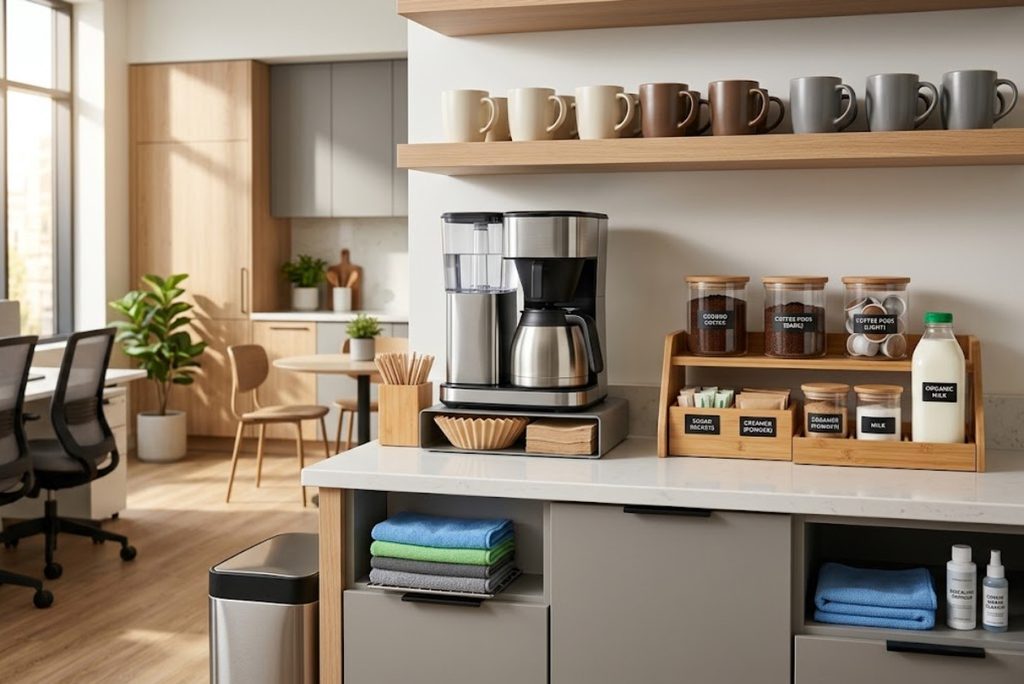
How to Set Up a Better Office Coffee Station
The coffee maker itself is only part of the setup.
Place the machine near an electrical outlet but away from areas where cords could create hazards.
Keep mugs, filters, coffee grounds and pods close enough to access without creating countertop clutter.
If your office uses several coffee varieties, use clearly organized containers rather than placing open boxes around the machine.
A small waste container nearby can also make cleanup easier.
For larger offices, consider separating the coffee preparation area from the main food-preparation area.
This can reduce congestion during busy periods.
Final Verdict
The best office coffee maker depends primarily on how many people use it, how frequently coffee is brewed and how much variety employees want.
For individual cups and beverage variety, the Keurig K155 OfficePRO is a strong commercial-oriented choice. Its 90-ounce reservoir and multiple cup sizes make it particularly suitable for shared use.
For fast full-pot brewing, the BUNN Speed Brew Classic Thermal stands out because BUNN says it can brew a 10-cup carafe in about four minutes.
For larger teams that prefer traditional drip coffee, the Cuisinart 14-Cup Programmable Coffee Maker offers substantial capacity and programmable brewing.
The BLACK+DECKER 12-Cup Programmable Coffeemaker is a practical budget-oriented choice for offices that want straightforward features without a complicated system.
The Hamilton Beach FlexBrew Trio is particularly interesting for mixed preferences because it can handle pods, grounds and a full carafe.
The OXO Brew 8-Cup Coffee Maker is better suited to smaller professional teams that care about brewing quality and thermal-carafe convenience.
Finally, the Keurig K-1550 is designed specifically for small-business environments and offers a large 96-ounce reservoir, multiple cup sizes and quieter brewing technology.
There is no single winner for every workplace.
A three-person home office has completely different requirements from a 30-person company. The smartest approach is to calculate actual coffee consumption, choose an appropriate brewing method, check the machine’s intended-use rating, and select features that employees will genuinely use.
If you’re building a coffee setup on a limited budget, our guide How to Choose the Best Coffee Maker Under $100 can help you decide which features deserve your money.
For offices that want a traditional full pot, prioritize capacity, speed and easy cleaning. For workplaces where everyone wants something different, single-serve or hybrid brewing may be more practical.
The best office coffee maker is ultimately the one that can handle your team’s routine without becoming another appliance that nobody wants to maintain.
Frequently Asked Questions
What is the best type of coffee maker for an office?
There is no single best type. Drip coffee makers work well for teams that share a pot, while single-serve machines work better when employees have different preferences.
How many cups should an office coffee maker make?
For a small office, 8–10 cups may be sufficient. Larger teams may need a 12- or 14-cup machine or a commercial single-serve brewer.
Is a Keurig good for an office?
A commercial Keurig model can be well suited to office environments, especially when employees want individual cups. However, make sure you choose a model intended and rated for workplace use rather than automatically using a household model.
Is a thermal carafe better for an office?
It can be. A thermal carafe can keep coffee warm without requiring a warming plate, which is convenient when employees drink coffee at different times.
Is a 12-cup coffee maker enough for an office?
It can be enough for a small or medium office depending on actual coffee consumption. The number of employees alone is not enough to determine the required capacity.
What is more economical for an office: pods or ground coffee?
Ground coffee will often have a lower cost per serving, while pods provide convenience and individual choice. The best option depends on how much the office values convenience versus ongoing beverage costs.
Should an office buy a commercial coffee maker?
For heavy or continuous workplace use, a commercial-rated machine may be more appropriate than a household model. Always follow the manufacturer’s intended-use and safety recommendations.
How often should an office coffee maker be cleaned?
Basic cleaning should be performed regularly according to the manufacturer’s instructions, while descaling frequency depends on the machine, water quality and usage. Keurig, for example, recommends descaling its office brewers every three to six months depending on the water source.
Conclusion
Coffee is a small part of the workday, but a good office coffee station can make a surprisingly big difference.
The right machine should match the number of people using it, the amount of coffee they consume, their preferred brewing style and the amount of space available.
A small office may benefit from a compact 8-cup brewer. A larger team may need a 12- or 14-cup machine. A workplace with different beverage preferences may be better served by a commercial single-serve brewer or a flexible machine capable of both individual cups and full carafes.
Before buying, look beyond the price tag. Check capacity, brewing speed, water-reservoir size, cleaning requirements, intended-use rating, counter space and the cost of consumables.
Most importantly, choose a machine that employees can use easily and maintain consistently.
A coffee maker should make the office more convenient—not create another daily task that everyone tries to avoid.