

Introduction
A small kitchen does not mean you have to give up the pleasure of brewing fresh coffee at home. The real challenge is choosing a coffee maker that gives you the features and capacity you need without taking over the limited countertop space you actually have. A machine may look compact in a product photograph, but its real footprint includes its width, depth, height, water-reservoir access, carafe clearance and the space you need around it for everyday use.
This guide Best Coffee Makers for Small Kitchens focuses on coffee makers that can work particularly well in apartments, dorm rooms, office kitchens, studio homes, RVs and other spaces where every inch of counter space matters. Rather than simply choosing the smallest machine available, we consider different brewing styles, capacities, convenience features and the type of coffee drinker each machine suits best.
If you’re still deciding between brewing methods, our previous guide Drip Coffee Maker vs Single Serve Coffee Maker: Which Is Better? can help you understand the basic difference between these two popular approaches before choosing a compact machine.
The seven coffee makers discussed below cover different needs, from extremely narrow single-serve machines to compact drip brewers that can prepare several cups at once. The goal is not simply to find a small coffee maker, but to find one that makes sense for your kitchen and your daily coffee routine.
What Makes a Coffee Maker Good for a Small Kitchen?
Before looking at individual models, it helps to understand what “compact” actually means. Width is often the first specification people check, but it is only part of the story.
A narrow coffee maker can still be inconvenient if it is very deep or if you need to pull it away from the wall every time you refill the water reservoir. Likewise, a short machine may still be difficult to place underneath cabinets if the top needs to be opened during brewing.
Width
Width is especially important when your countertop is narrow from side to side. A machine that is only four or five inches wide can leave valuable space for a toaster, blender or food-preparation area.
For example, Keurig’s K-Mini is listed at just 4.5 inches wide, making it particularly attractive for extremely narrow counters.
Depth
Depth is easy to overlook. Measure from the backsplash or wall to the front edge of your counter before buying.
A machine that fits perfectly from side to side may still occupy too much of your working area if it extends far toward you.
Height and cabinet clearance
Do not measure only the machine itself. Check whether the water reservoir, filter basket, lid or pod compartment needs additional vertical clearance.
A coffee maker might technically fit under a cabinet but still become frustrating to use if you cannot comfortably open it.
Water-reservoir access
For a small kitchen, front-access or easily removable reservoirs can be particularly convenient. If you have to move the machine every morning to add water, its compact dimensions will not necessarily translate into convenient everyday use.
Brewing capacity
A tiny coffee maker is not automatically the best choice.
If you regularly prepare coffee for three or four people, a one-cup machine could actually create more work because you will have to brew repeatedly. A slightly larger machine may use more counter space but save time every morning.
This is why the right compact coffee maker depends on your coffee routine, not just the smallest published dimensions.
7 Best Coffee Makers for Small Kitchens
1. Keurig K-Mini — Best Ultra-Compact Single-Serve Pick
If countertop width is your biggest problem, the Keurig K-Mini is one of the easiest machines to consider. Keurig lists it at 4.5 inches wide, 11.3 inches deep, and 12.1 inches high, with a 6–12-ounce brewing range depending on the current version and configuration. It uses a single-cup water reservoir, so you add fresh water for each brew.
That narrow width is the major attraction. In a kitchen where a few extra inches could make the difference between having room for a coffee maker and having to store it elsewhere, the K-Mini’s slim footprint can be extremely useful.
It is particularly suitable for someone who normally prepares one cup at a time. It also makes sense for dorm rooms, office corners, guest rooms, and small apartments.
The tradeoff is capacity. If your household drinks a full pot of coffee every morning, a single-serve machine may not be the most efficient option.
Another consideration is the pod-based brewing system. If you prefer grinding whole beans and experimenting with different brewing variables, a compact drip or manual brewer may offer more flexibility.
Best for: Extremely limited counter space and one-cup coffee drinkers.
Main advantage: Very narrow footprint.
Potential drawback: Less suitable for brewing several cups at once.

2. Mr. Coffee 5-Cup Mini Brew — Best Simple Budget Drip Pick
For people who prefer traditional drip coffee rather than single-serve pods, the Mr. Coffee 5-Cup Mini Brew offers a more conventional approach in a smaller format.
The current Mr. Coffee 5-Cup model makes up to 25 ounces, which the manufacturer describes as suitable for approximately two 12-ounce cups. Its listed dimensions are 8.8 inches long, 6.4 inches wide, and 10 inches high. It also includes a water-level window, Grab-a-Cup Auto Pause, a removable filter basket, and an ergonomic carafe.
This makes it an appealing option for a couple or a person who wants more than a single serving but does not need a traditional 10- or 12-cup coffee maker.
Its simple operation is also useful in a small kitchen. There is less equipment to manage and the smaller carafe does not dominate the counter.
The 5-cup format can be a better compromise than choosing an ultra-small single-serve machine when you want to prepare coffee for yourself and another person at the same time.
If your main concern is affordability, this type of compact drip machine also fits well with the advice in How to Choose the Best Coffee Maker Under $100, where we discussed how to prioritize useful features instead of paying for options you may never use.
Best for: Couples, small households and budget-conscious buyers.
Main advantage: Traditional drip brewing in a small footprint.
Potential drawback: The 25-ounce capacity is limited for larger households.
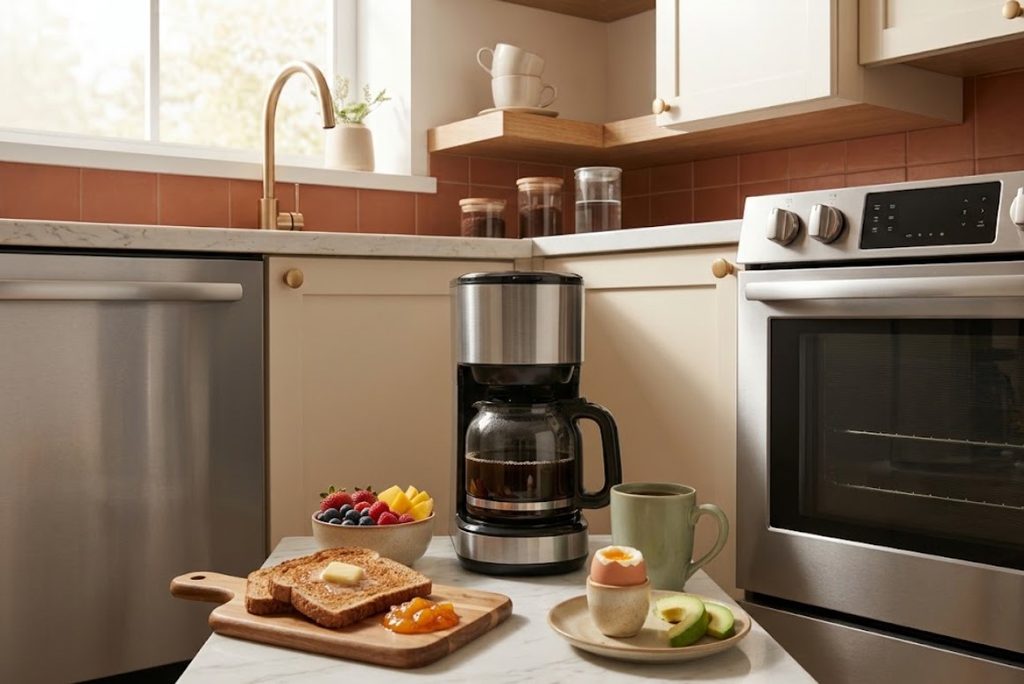
3. Cuisinart 5-Cup Coffee Maker with Stainless Steel Carafe — Best Small-Space Traditional Pick
The Cuisinart DCC-5570NAS is another interesting choice for people who want a traditional coffee maker without dedicating a large section of their counter to it.
Cuisinart lists this model at 10.14 inches wide, 5.67 inches deep, and 10.85 inches high. It has a 5-cup stainless-steel carafe, removable water reservoir, Brew Pause feature, a 30-minute keep-warm function and a charcoal water filter.
One of its strongest advantages for a small kitchen is the combination of a compact body and stainless-steel carafe. A stainless carafe can also be useful if you prefer a different look from the traditional glass-carafe machines that occupy many kitchen counters.
The 5-cup capacity makes it more appropriate for one or two coffee drinkers than for a large family. But that limitation can actually be an advantage if you live alone or with one other person because you are not dedicating counter space to a large 10- or 12-cup machine you rarely fill.
The removable water reservoir is another useful feature. Everyday convenience matters more in a small kitchen because moving appliances around repeatedly can quickly become annoying.
Best for: People who want a traditional drip coffee maker with a stainless-steel carafe.
Main advantage: Compact design with stainless-steel carafe.
Potential drawback: Limited capacity compared with full-size machines.

4. OXO Brew 8-Cup Coffee Maker — Best for Better Brewing in a Compact Footprint
If you have limited space but still want a more advanced drip-brewing experience, the OXO Brew 8-Cup Coffee Maker is worth considering.
OXO lists the machine at 7 inches wide, 10.5 inches deep, and 13.5 inches high. It has an 8-cup capacity and uses a double-wall, vacuum-insulated thermal carafe. The machine can brew a single cup or a full carafe and is certified by the Specialty Coffee Association for meeting its home-brewing standards.
That combination makes it particularly interesting for households that want both capacity and a relatively compact footprint.
The thermal carafe is also useful because it avoids relying on a traditional hot plate to keep coffee warm. OXO specifically describes its brewing system as using the thermal carafe to prevent heat loss rather than repeatedly reheating the coffee.
The machine also has a Rainmaker showerhead designed to distribute water over the coffee grounds and a bloom cycle intended to support extraction.
For a small kitchen, however, remember that the machine is still taller than some basic compact models. Measure the available cabinet clearance before buying.
If you are interested specifically in thermal-carafe designs, this model also fits naturally alongside our article Best Coffee Makers with Thermal Carafes: 7 Top Picks, where we look more closely at the advantages of insulated carafes.
Best for: Coffee drinkers who want better brewing features without moving to a very large machine.
Main advantage: 8-cup capacity, thermal carafe, and precision brewing features.
Potential drawback: Taller and more expensive than basic compact coffee makers.

5. BLACK+DECKER 12-Cup QuickTouch — Best for Maximum Capacity
At first glance, a 12-cup coffee maker might not sound like a logical recommendation for a small kitchen. However, there are situations where capacity matters more than absolute compactness.
The BLACK+DECKER 12-Cup QuickTouch Programmable Coffee Maker measures 12.3 inches wide, 8.3 inches long, and 11 inches high. It offers 24-hour programming, an easy-read display, a front-facing water-level window, Sneak-A-Cup technology and a 12-cup glass carafe.
This is therefore not the narrowest machine in our list. Instead, it is included for households that have limited space but still need to brew a larger amount of coffee.
For example, a family might have only one practical appliance section on the countertop. In that situation, using a single larger machine may be more convenient than keeping a smaller brewer and repeatedly making multiple batches.
The downside is obvious: it takes more counter space than the truly compact options above.
It is also a glass-carafe machine with a warming plate, so it serves a different purpose from the thermal-carafe models discussed elsewhere in this guide.
Best for: Larger households that need a full pot.
Main advantage: Large 12-cup capacity with programmable brewing.
Potential drawback: Not genuinely ultra-compact.
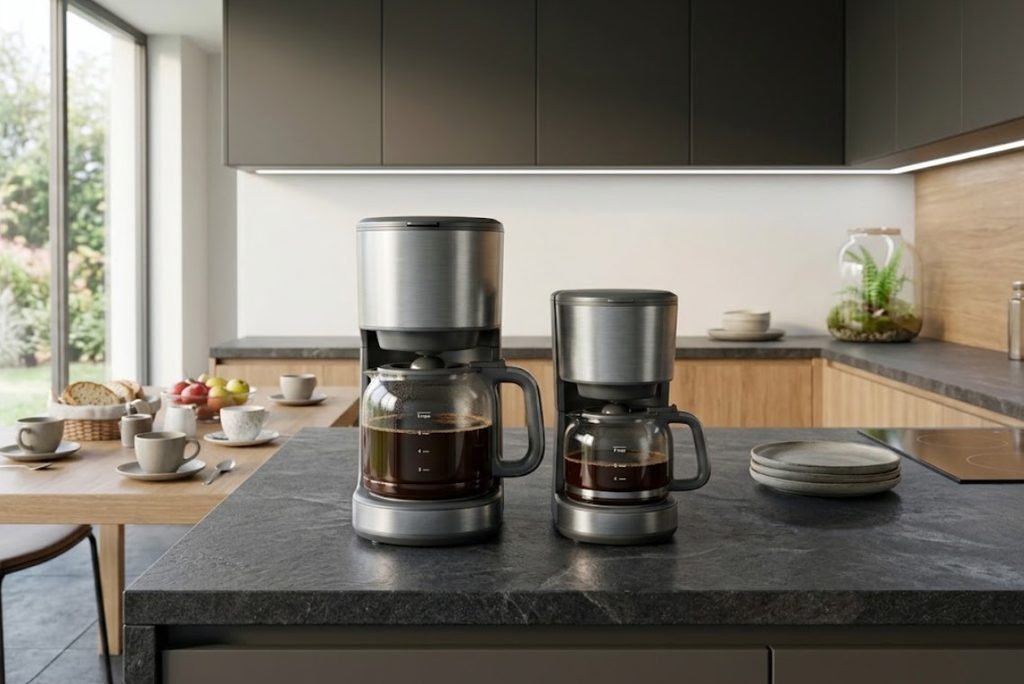
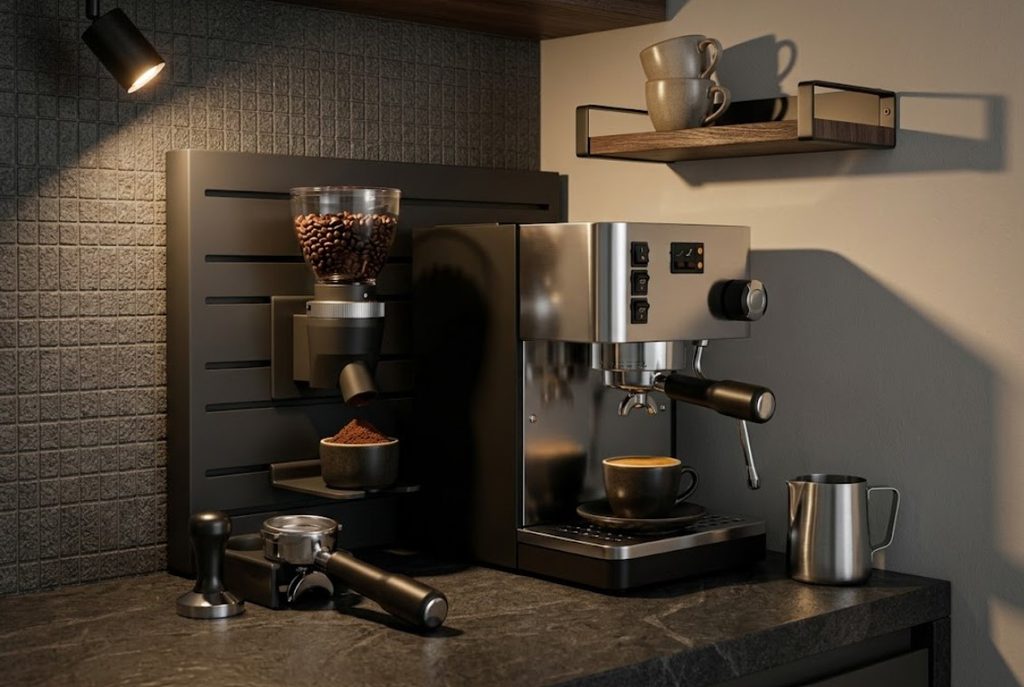
6. Breville Bambino — Best Compact Espresso Option
Not everyone searching for a coffee maker for a small kitchen means a traditional drip machine. If espresso-based drinks are your priority, a compact espresso machine can make better use of limited space than a large café-style setup.
The Breville Bambino has a compact footprint and is designed for espresso preparation. Breville lists its dimensions at 11.9 inches wide, 6.1 inches deep and 13.5 inches high. It uses a 54 mm portafilter and features low-pressure pre-infusion followed by 9-bar extraction. It also has a steam wand for manually creating microfoam.
The important point is that the Bambino is not a complete one-appliance coffee station. You will generally need a grinder if you want to use fresh whole beans, and the grinder itself needs counter space.
Therefore, someone with an extremely small kitchen should calculate the total footprint of the espresso setup, not just the machine.
This is a good example of why “smallest coffee maker” and “best coffee maker for a small kitchen” are not always the same thing.
If you mainly drink espresso, lattes or cappuccinos, however, a compact espresso machine may be a better choice than purchasing a larger drip machine that does not match your normal coffee routine.
Best for: Espresso and milk-based coffee drinkers.
Main advantage: Compact espresso-focused design.
Potential drawback: A separate grinder increases the total footprint.
7. Keurig K-Mini Mate — Best for the Smallest Possible Footprint
For buyers who want to push space-saving as far as possible, the newer Keurig K-Mini Mate deserves attention.
Keurig describes the K-Mini Mate as its smallest brewer, measuring just 4 inches wide and designed for small kitchens, dorm rooms, and tiny apartments. It brews up to a 12-ounce cup and uses a one-cup reservoir.
Its major selling point is not a large capacity or advanced programming. It is simply the ability to put a coffee maker into a space where many other machines would not fit.
This can be particularly useful in a narrow apartment kitchen, an office nook or a dorm room where countertop width is extremely limited.
As with other single-serve pod machines, the tradeoff is that you are making individual cups rather than a full carafe.
If your coffee routine is simply “wake up, make one cup, and leave,” that may not matter at all.
For a household that drinks a pot together, however, a small drip brewer will probably be more practical.
Best for: Extremely narrow counters and one-cup users.
Main advantage: Around 4 inches wide.
Potential drawback: Designed primarily around individual servings.

How to Choose the Best Coffee Maker for Your Small Kitchen
Choosing between these seven options is easier when you think about your actual routine instead of simply comparing product sizes.
Start with your daily number of cups
If you drink one cup, a single-serve machine can be ideal.
If two people drink coffee, a 5-cup brewer may be more convenient.
If you regularly serve several people, moving toward an 8- or 12-cup machine may make more sense even if it takes more counter space.
Measure the countertop before buying
Take three measurements:
Width: How much horizontal space is available?
Depth: How far can the appliance extend toward the front edge?
Height: Is there enough room beneath cabinets to open the reservoir or filter compartment?
Do not rely on photographs.
Think about where the water goes
A removable water reservoir is convenient, but it can also require additional clearance.
A top-loading machine may be difficult to use beneath low cabinets.
A front-access system may be better for a cramped countertop.
Consider storage
Some people do not need their coffee maker to remain on the counter all day.
If you have a cabinet or shelf where the appliance can be stored, a lightweight machine can be taken out when needed.
However, avoid choosing a machine that is so inconvenient to move that you eventually leave it permanently on the counter.
Single-Serve vs. Compact Drip Coffee Makers
Single-serve machines generally win when space and convenience are the highest priorities.
You can make one cup quickly without preparing a full pot, and extremely narrow models can fit into surprisingly small spaces.
Compact drip coffee makers win when multiple cups and traditional brewing matter more.
A 5-cup machine may take slightly more space than a tiny pod brewer but can eliminate the need to brew several individual cups.
The right choice therefore depends on your household.
If you are still unsure about the basic brewing difference, Drip Coffee Maker vs Single Serve Coffee Maker: Which Is Better? is a useful article to read before making the final decision.
What Features Are Worth Paying For?
Small kitchens do not necessarily require fewer features. They require more carefully selected features.
Programmability
If you have a predictable morning schedule, programmable brewing can save time.
However, if you normally brew coffee only when you wake up, paying more for extensive programming may not provide much benefit.
Our earlier article Best Programmable Coffee Makers for Home: 7 Top Picks goes deeper into programmable features if that is important to your routine.
Thermal carafe
A thermal carafe can be valuable if you make coffee and drink it gradually.
Instead of leaving coffee sitting on a hot plate, the insulated carafe is designed to retain heat.
Removable parts
A removable water reservoir or filter basket can make cleaning easier.
In a small kitchen, easy maintenance is particularly important because you may not have a large sink or dedicated cleaning area.
Auto shutoff
This is a useful convenience and safety feature, particularly for busy mornings.
Brew-size flexibility
If you sometimes want one cup and sometimes want several cups, choose a machine that can accommodate both situations.
Common Mistakes to Avoid
Buying based only on width
A machine can be narrow but extremely deep.
Always measure the complete footprint.
Ignoring cabinet clearance
A coffee maker that fits under the cabinet may still be difficult to refill.
Check the opening direction of the reservoir and filter compartment.
Buying too little capacity
A one-cup machine may look perfect until you discover that you have to brew four times every morning.
Buying too much capacity
The opposite mistake is purchasing a 12-cup machine for one person who drinks one mug a day.
That wastes both space and brewing capacity.
Forgetting the accessories
Espresso machines especially require additional equipment. A compact espresso machine plus a grinder can occupy more space than a compact drip brewer.
Choosing appearance over workflow
A beautiful coffee maker that is difficult to refill or clean will become frustrating.
Prioritize the way you will actually use it.

How to Organize a Coffee Station in a Small Kitchen
Once you have selected a machine, organization can make an even bigger difference.
Keep the coffee maker close to the water source if possible.
Store filters and pods in a small container rather than allowing them to spread across the counter.
Use vertical cabinet space for mugs.
Keep coffee beans or grounds in one compact container.
If your machine has a removable reservoir, leave enough room to remove it without moving several other appliances.
You can also create a dedicated coffee corner rather than spreading coffee equipment across the entire countertop.
The goal is to make coffee preparation feel simple while keeping the rest of your kitchen available for cooking.
Final Verdict
The best coffee maker for a small kitchen depends on how you drink coffee.
For the smallest countertop footprint, the Keurig K-Mini and Keurig K-Mini Mate are strong choices because their narrow designs are built specifically around space saving. Keurig lists the K-Mini at 4.5 inches wide and the K-Mini Mate at 4 inches wide.
For a traditional compact drip brewer, the Mr. Coffee 5-Cup Mini Brew and Cuisinart DCC-5570NAS make more sense for people who want several servings without moving to a full-size machine.
If you want more advanced brewing in a compact package, the OXO Brew 8-Cup is particularly interesting because it combines an 8-cup capacity with a thermal carafe and SCA certification.
For larger households, the BLACK+DECKER 12-Cup QuickTouch demonstrates an important point: sometimes a slightly larger appliance is more practical than repeatedly brewing small batches.
And if espresso is your priority, the Breville Bambino offers a compact alternative to larger espresso machines, although the additional grinder must be considered when calculating your total counter space.
Ultimately, don’t choose the smallest coffee maker simply because your kitchen is small. Choose the smallest machine that comfortably matches your coffee routine. Measure your counter, check cabinet clearance, consider the number of cups you normally brew and think about how easy the machine will be to refill and clean.
For readers interested in broader coffee-brewing standards, the Specialty Coffee Association’s Certified Home Brewers program is another useful resource for understanding how home brewing equipment can be evaluated against established brewing standards.
If you’re building a complete coffee-maker setup, our related guides How to Choose the Best Coffee Maker Under $100, Best Programmable Coffee Makers for Home: 7 Top Picks and Best Coffee Makers with Thermal Carafes: 7 Top Picks can help you compare different priorities before making your final choice.
Frequently Asked Questions
What is the smallest type of coffee maker for a small kitchen?
Single-serve pod machines are generally among the narrowest electric options. Models such as the Keurig K-Mini and K-Mini Mate are designed specifically around compact footprints.
Is a 5-cup coffee maker enough for two people?
It can be. A 5-cup machine such as the Mr. Coffee Mini Brew makes up to 25 ounces, which the manufacturer describes as approximately two 12-ounce cups.
Is a thermal carafe better for a small kitchen?
It can be, especially if you want to avoid leaving a warming plate running beneath a glass carafe. A thermal carafe can also make it easier to move brewed coffee away from the coffee maker and free the appliance area for other tasks.
Should I buy a single-serve or drip coffee maker?
Choose single-serve if you normally make one cup at a time and value minimum footprint. Choose drip if you regularly make coffee for two or more people.
How much counter space should I leave around a coffee maker?
Leave enough room to safely operate the machine, refill its water reservoir, remove the filter basket, place your cup or carafe, and clean around it. The exact clearance depends on the machine’s design.
Can an espresso machine work in a small kitchen?
Yes. Compact espresso machines such as the Breville Bambino can fit relatively tight spaces, but remember that you may also need a grinder, tamper area, and space for a milk pitcher if you make milk drinks.
Is the smallest coffee maker always the best choice?
No. The smallest machine may have limited capacity or fewer features. The best choice is the machine that provides enough capacity and convenience while fitting comfortably into your available space.
Conclusion
Small kitchens require smarter appliance choices, not fewer enjoyable routines. Whether you need a tiny single-serve machine, a compact 5-cup drip brewer, an 8-cup thermal-carafe model or a compact espresso machine, there are options that can fit into limited spaces.
Before buying, measure your counter, consider your household’s coffee habits, check cabinet clearance and think about how often you will need to refill and clean the machine.
A compact coffee maker should make your kitchen feel more convenient—not more crowded. Choose according to your real daily routine, and you can enjoy fresh coffee without sacrificing the valuable countertop space you need for everything else.