

Introduction
Choosing between an immersion blender vs regular blender can be surprisingly difficult if you are buying your first blending appliance. Both can blend ingredients, make sauces, prepare soups and handle many everyday kitchen tasks, but they work in very different ways. One is designed to be placed directly into a pot, bowl or container, while the other uses a dedicated blending jar with blades positioned at the bottom.
The better choice depends on what you normally prepare, how much food you make at once, how much storage space you have and how important convenience is to you. In this guide, we compare an immersion blender with a regular blender through seven important differences, including blending performance, capacity, versatility, cleaning, storage, safety and cost. We will also explain which option makes more sense for smoothies, soups, sauces, baby food and other common kitchen tasks.
What Is an Immersion Blender?
An immersion blender, sometimes called a stick blender or hand blender, is a handheld appliance with a motor at one end and a small blending blade at the other. Instead of placing ingredients inside a separate blender jar, you place the blade directly into the food you want to process.
This design makes an immersion blender particularly useful for foods that are already being prepared in a pot or bowl. For example, if you are cooking a vegetable soup on the stove, you can often blend the soup directly inside the cooking pot after following the manufacturer’s instructions.
The compact design is one of its biggest advantages. An immersion blender usually takes considerably less storage space than a full-size countertop blender, making it attractive for smaller kitchens.
It can also reduce the number of dishes you need to wash because you may not need to transfer food from a cooking pot into another container.
If you are completely new to blenders and want to understand the basic appliance before comparing different designs, our guide “What Is a Blender” provides a useful introduction.
What Is a Regular Blender?
A regular blender, often called a countertop blender, consists of a motor base and a removable blending jar or pitcher. Ingredients are placed inside the container, the lid is secured and the motor rotates the blades at the bottom.
Countertop blenders are particularly popular for smoothies, shakes, frozen drinks and other recipes where ingredients need to be pulled downward toward the blades and circulated through the container.
The larger container also makes them useful when preparing multiple servings.
The two designs therefore have different strengths. An immersion blender emphasizes direct blending, compactness and convenience, while a regular blender emphasizes container-based blending, capacity and high-volume preparation.
7 Key Differences Between an Immersion Blender and a Regular Blender
1. Blending Method
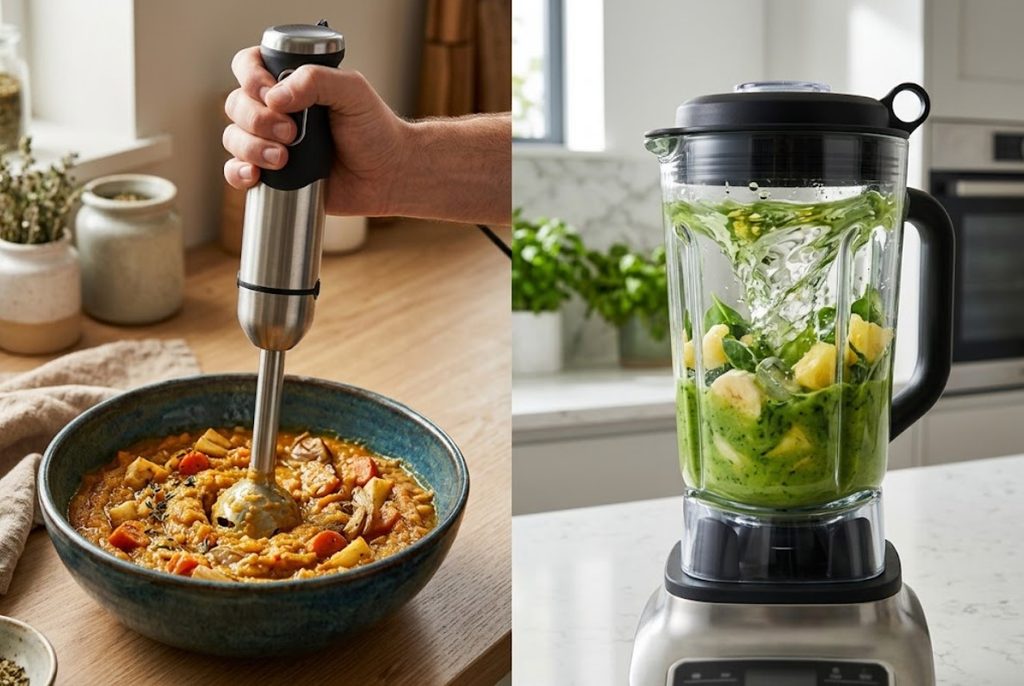
The most obvious difference is how the two appliances interact with ingredients.
An immersion blender is placed directly into the food. You control its position with your hand and move the blade through the mixture as necessary.
A countertop blender does the opposite. The ingredients remain inside the blender jar while the rotating blades and container shape help circulate them.
This difference affects how each appliance feels during use.
With an immersion blender, you have more direct control over where the blade is working. This can be useful when blending a soup that contains vegetables of different sizes or when processing a smaller amount of sauce.
A countertop blender provides a more contained blending environment. Once the ingredients are loaded and the lid is secured, you can operate the appliance without physically holding it in the mixture.
2. Smoothie Performance
For smoothie lovers, a regular countertop blender is generally the more natural choice.
The container, blade position and motor are designed to create circulation inside the jar. This is especially helpful when blending combinations of fruit, liquid, ice and frozen ingredients.
An immersion blender can process soft fruits and liquids, but it is not usually the first choice when your goal is consistently smooth frozen-fruit smoothies.
For example, someone who regularly makes smoothies using frozen berries, ice, bananas and yogurt may find a countertop blender more convenient.
The blending performance also depends heavily on the specific model. Motor power, blade design, container shape and ingredient ratios all influence the final texture.
If smoothies are your main reason for buying a blender, our article “Best Blenders for Smoothies: 7 Picks for Fast and Good Blending” provides a more focused look at smoothie-oriented blender choices.

3. Soup and Sauce Preparation
This is an area where an immersion blender can have a major advantage.
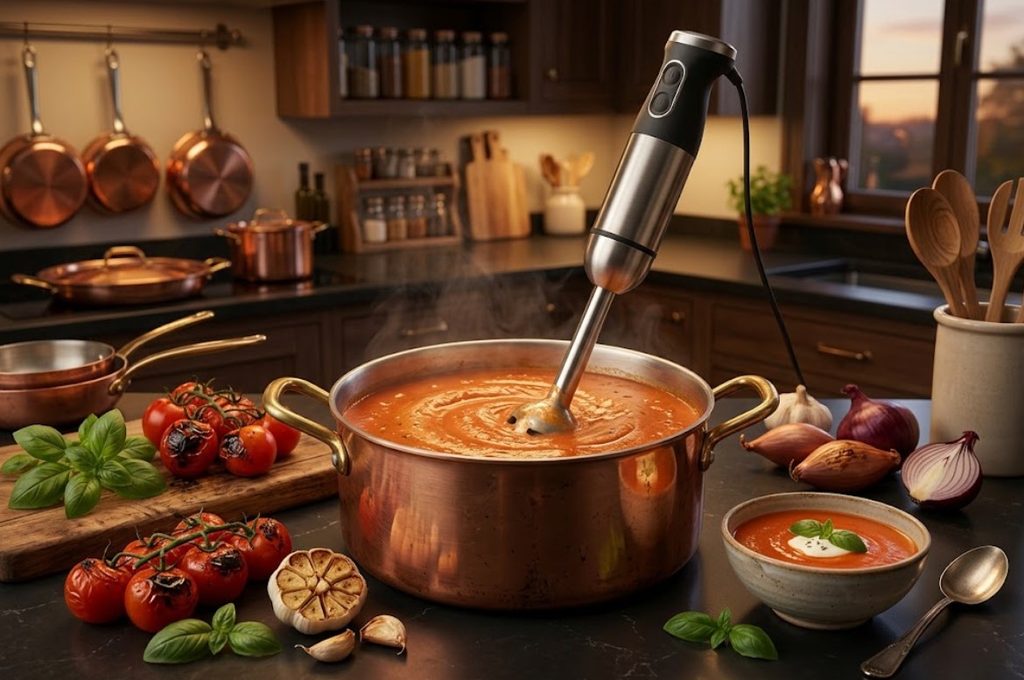
Imagine making a large pot of tomato soup. With a countertop blender, you may need to transfer portions of the hot soup into the blender jar, blend them and then return the soup to the pot.
That process can create additional dishes and requires careful handling.
An immersion blender can potentially simplify the process because the blade can be placed directly into the cooking vessel, provided the appliance and cookware are appropriate and the manufacturer’s instructions allow it.
This is also useful for sauces, purees and other soft mixtures.
However, you should never assume that every immersion blender is suitable for every hot-liquid situation. Always follow the manufacturer’s instructions regarding temperature, container depth and safe operation.
For detailed guidance about safe handling of kitchen appliances and hot foods, manufacturer instructions are one of the most useful sources to check before use.
4. Capacity and Batch Size
Capacity is another major difference.
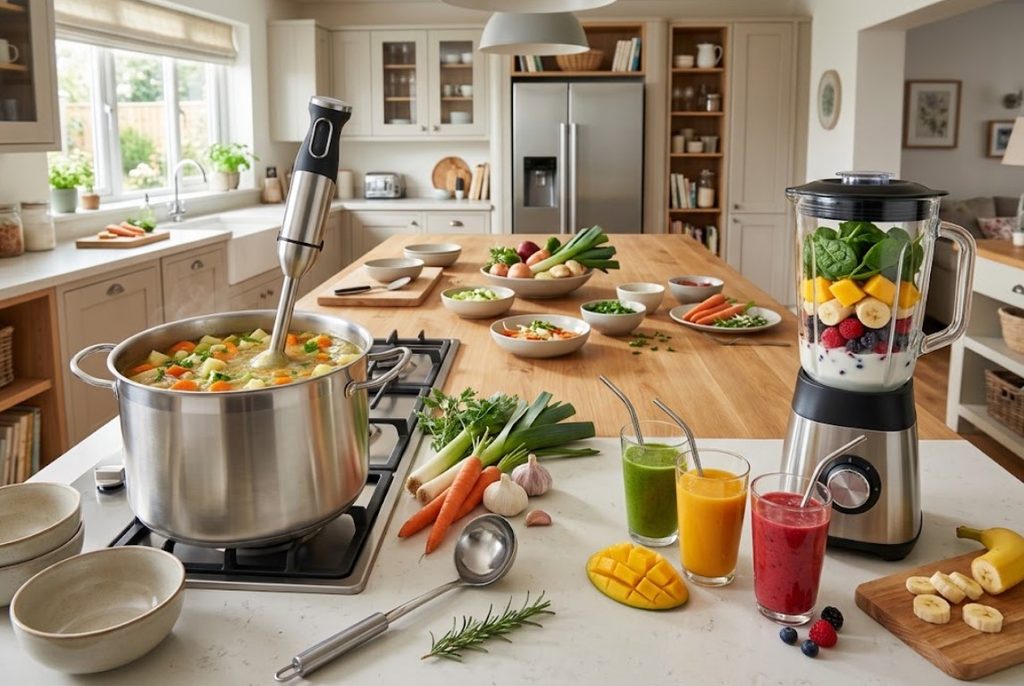
A regular blender usually comes with a dedicated pitcher that can hold considerably more ingredients than the small working area of an immersion blender.
This makes countertop blenders more convenient when preparing several smoothies, large batches of sauce or drinks for multiple people.
An immersion blender does not have to be limited to a tiny amount, however. Its advantage is that you can use it in an appropriately sized pot, bowl or container. The actual capacity therefore depends partly on the vessel you are using.
This can make an immersion blender surprisingly practical for large pots of soup.
The difference is really about where the food is stored during blending.
A countertop blender requires ingredients to fit inside its designated jar.
An immersion blender allows the food to remain in the cooking or preparation container.
5. Cleaning and Convenience
Cleaning can make a surprisingly large difference in how often you use an appliance.
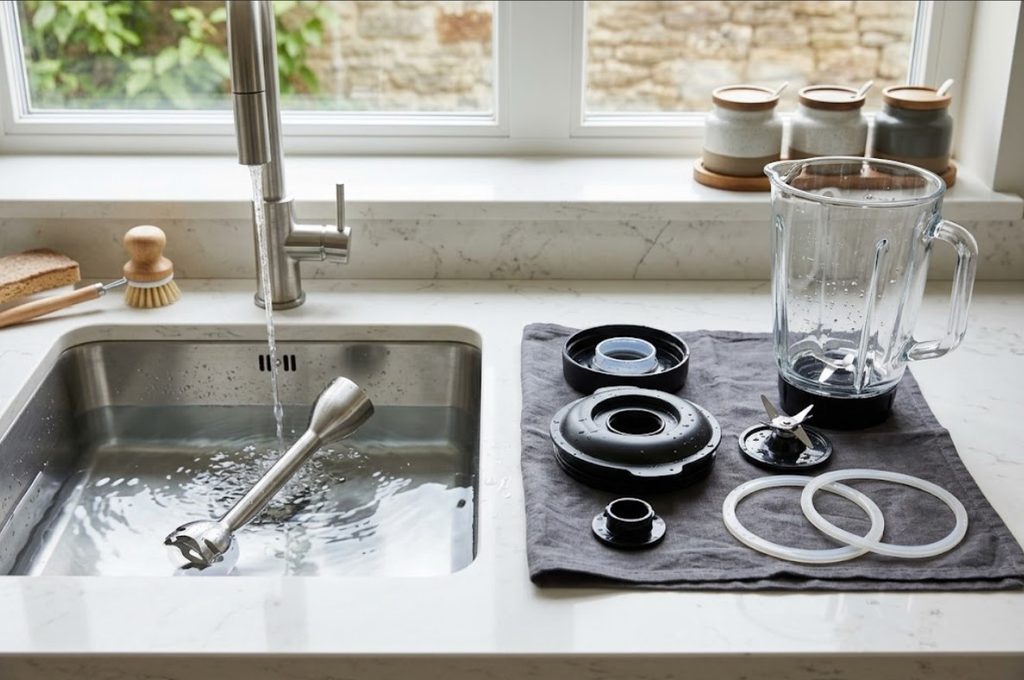
A countertop blender usually requires you to clean the pitcher, lid and blade area after use. Depending on the design, food may become trapped around the blade assembly or underneath the lid.
An immersion blender can be easier to clean because the blending shaft is relatively compact. Some models also have detachable shafts that can make cleaning more convenient.
However, an immersion blender can create splashing if used incorrectly, particularly in a shallow container or at an inappropriate speed.
The best cleaning experience therefore depends on both the appliance design and your habits.
After blending, cleaning the appliance promptly can prevent food from drying around the blades and other components.
Never immerse a motor housing or electrical component in water unless the manufacturer specifically states that it is designed for such cleaning.
6. Storage and Kitchen Space
If you have a small kitchen, storage can become just as important as performance.
A countertop blender has a motor base, pitcher and lid, so it generally requires a dedicated storage area. Some models are compact, but a full-size countertop blender can still occupy valuable counter or cabinet space.
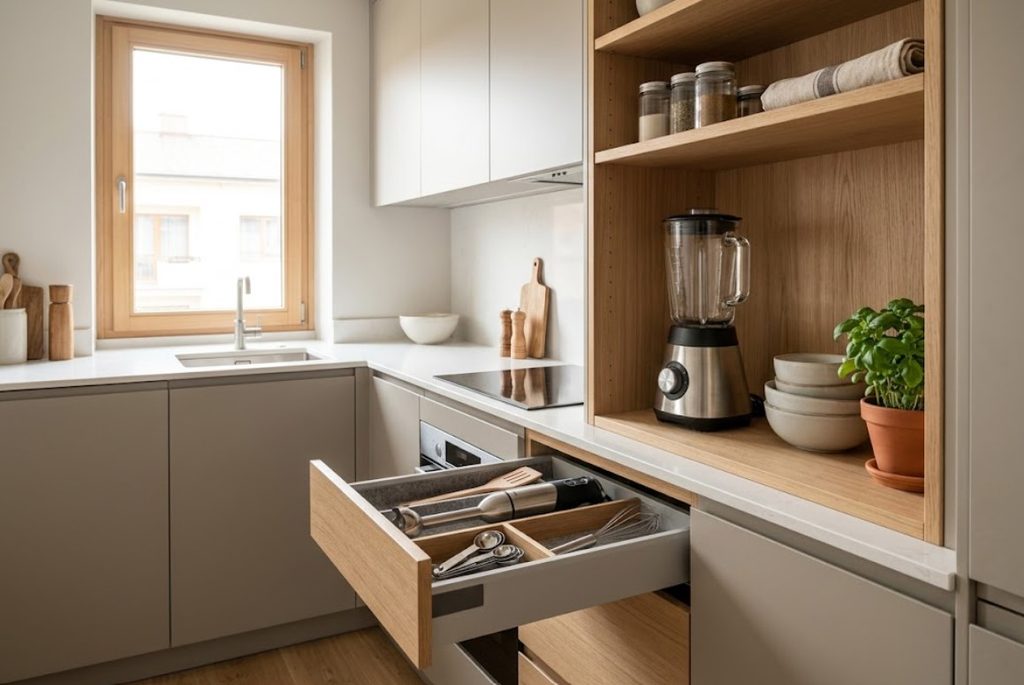
An immersion blender is much easier to store in many kitchens. Its slim shape can fit inside a drawer or narrow cabinet.
This makes it particularly appealing to students, apartment residents, small households and people who do not want another large appliance permanently sitting on their counter.
There is also a psychological benefit to compact storage. When an appliance is easy to access, you may be more likely to use it.
7. Versatility and Everyday Uses
Both appliances are versatile, but their strengths are different.
An immersion blender can be useful for:
- Soups
- Sauces
- Gravies
- Purees
- Baby food
- Small batches
- Whipped mixtures
- Certain smoothies
- Soft ingredients
A regular blender can be useful for:
- Smoothies
- Protein shakes
- Frozen drinks
- Ice-based recipes
- Sauces
- Dips
- Purees
- Larger batches
- Some hot-food applications when specifically supported by the manufacturer
The difference becomes clearer when you think about the type of food you prepare most often.
If you spend most of your time cooking soups and sauces, an immersion blender may provide more practical convenience.
If you make smoothies every morning or regularly blend frozen ingredients, a regular blender is likely to be more useful.

Immersion Blender vs. Regular Blender: Quick Comparison
| Feature | Immersion Blender | Regular Blender |
| Storage | Very compact | Requires more space |
| Smoothies | Good for some recipes | Usually better suited |
| Frozen ingredients | Model-dependent | Generally better suited |
| Soup | Excellent convenience | Requires more transferring |
| Sauces | Very convenient | Very versatile |
| Large batches | Depends on container | Convenient with large pitcher |
| Cleaning | Often simpler | More parts to clean |
| Portability | Easy to move | Less convenient |
| Direct blending | Yes | No |
| Counter space | Minimal | More substantial |
Which Is Better for Smoothies?
If smoothies are your main priority, a regular countertop blender is usually the safer choice.
Its container and blade system are designed specifically around circulating ingredients through the blades. This can be particularly useful for frozen fruit, ice and thicker smoothie mixtures.
An immersion blender can still be useful for simple smoothies made with soft fruits and sufficient liquid, especially when you are making a small serving.
However, if your smoothie routine involves frozen berries, ice, fibrous greens and thick mixtures, a countertop blender gives you more purpose-built capacity and control.
The important thing is not to choose an appliance simply because it is more powerful. Look at the entire blending system, including the jar, blades and intended use.
Which Is Better for Soup?
For soup, the immersion blender has a clear convenience advantage in many situations.
You can often blend directly in the cooking pot, meaning you do not have to transfer the soup into another container. This can reduce mess and make preparation quicker.
It is especially convenient for creamy vegetable soups, lentil soups and tomato-based recipes.
A countertop blender can also produce excellent soup textures, but transferring hot food can be less convenient and requires additional care.
Always follow the appliance manufacturer’s instructions for hot liquids. Some blender containers are designed for hot ingredients while others are not.
Which Is Better for Small Kitchens?
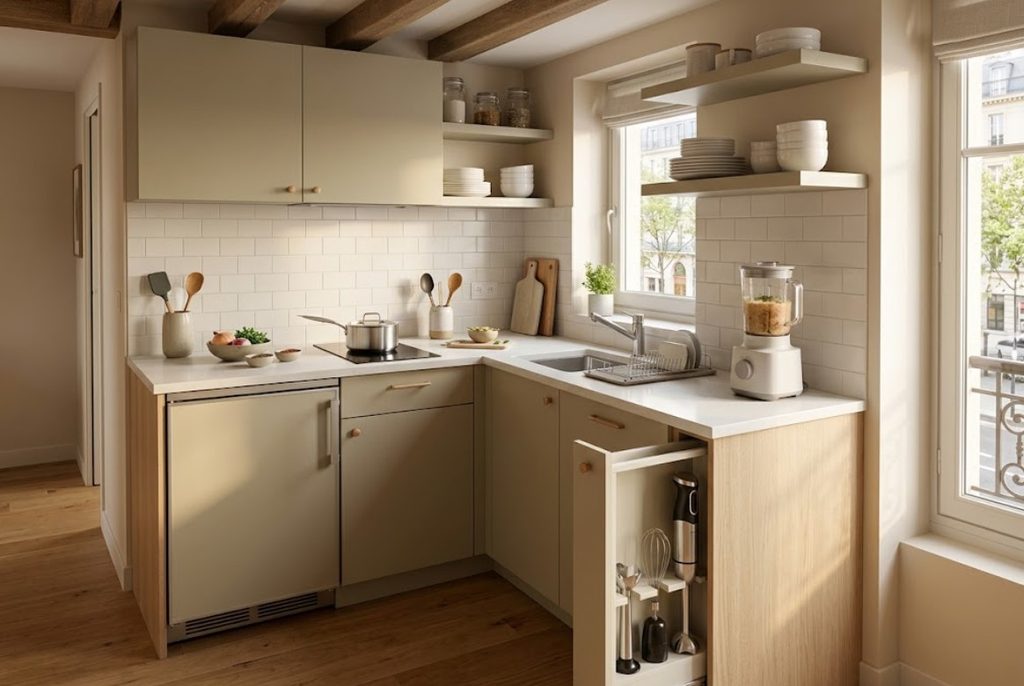
For a small kitchen, an immersion blender is usually the easier appliance to accommodate.
Its slim profile makes it easier to store, and it does not require a permanent countertop position.
A countertop blender may still be worth the space if you use it several times per week, especially for smoothies.
The decision therefore comes down to how much you value storage efficiency versus dedicated blending performance.
Which Is Better for Baby Food?
An immersion blender can be particularly convenient for small batches of pureed food.
Because you can blend directly in an appropriate container, you can process small quantities without filling a large pitcher.
A regular blender can also produce very smooth purees, especially when processing a larger batch.
Parents should always follow safe food-preparation practices and the manufacturer’s instructions for whichever appliance they choose.
For very small quantities, however, an immersion blender’s compact design can be more convenient.
Which One Is Easier for Beginners?
For simple cooking tasks, an immersion blender can be easier because there are fewer steps.
You do not necessarily need to transfer ingredients into a separate pitcher. Place the blending end into the appropriate container and operate it according to the manufacturer’s instructions.
A countertop blender is also straightforward once you become familiar with it. Its advantage is that the blending process is contained inside the jar.
Beginners should pay particular attention to safety. Keep fingers, utensils and other objects away from moving blades, secure lids properly and never attempt to remove stuck ingredients while the blades are moving.
Can You Replace a Regular Blender With an Immersion Blender?
Sometimes, but not completely.
If you mainly make soup, sauce, puree and small soft mixtures, an immersion blender may cover most of your needs.
If you regularly make smoothies with frozen fruit and ice, large batches of drinks or recipes requiring strong circulation through a pitcher, replacing a countertop blender entirely may not be practical.
For some households, owning both can make sense, but you do not necessarily need both.
Think about your most common recipes rather than the recipes you might make once a year.
Can You Replace an Immersion Blender With a Regular Blender?
You can perform many of the same basic blending tasks with a countertop blender, but the workflow may be less convenient.
For example, making soup with a countertop blender may require transferring the mixture from a pot into the pitcher and then returning it to the pot.
An immersion blender eliminates much of that transfer process.
This is why the two appliances should not be viewed simply as “small blender versus big blender.” Their designs solve different kitchen problems.
Common Mistakes to Avoid
Buying Only Based on Motor Power
A higher wattage number does not automatically mean a better appliance for your needs.
Consider the entire system, including blade design, container shape, controls and intended ingredients.
Choosing an Immersion Blender for Heavy Ice Crushing
Immersion blenders are not automatically designed for large amounts of ice or extremely hard ingredients. Always check the manufacturer’s instructions before attempting difficult blending tasks.
Ignoring Container Depth
When using an immersion blender, the container needs to be appropriate for the blender’s design. A container that is too shallow can increase splashing.
Forgetting Hot-Food Safety
Hot liquids can create pressure and splashing hazards. Follow the manufacturer’s instructions carefully.
Buying Both Without a Reason
Some people assume they need every type of blender. Before purchasing two appliances, identify what each one would actually do differently in your kitchen.
Which Blender Should You Choose?
Choose an Immersion Blender If You:
- Make soups frequently
- Prepare sauces and purees
- Have limited storage
- Prefer easy cleanup
- Make small batches
- Want to blend directly in a pot or bowl
- Value portability
Choose a Regular Blender If You:
- Make smoothies frequently
- Use frozen fruit
- Process ice-supported recipes
- Prepare several servings
- Want a dedicated blending pitcher
- Make thick drinks
- Want a more traditional countertop appliance
Is It Worth Having Both?
For people who cook frequently, having both can be useful.
A countertop blender can handle smoothies, frozen drinks and larger batches, while an immersion blender can take care of soups, sauces and smaller preparations.
However, owning both is not essential.
If your kitchen is small or your budget is limited, start with the appliance that matches your most common recipes.
Someone who makes smoothies every morning should probably prioritize a countertop blender.
Someone who cooks soup several times a week may get more value from an immersion blender.
Frequently Asked Questions
Is an immersion blender the same as a regular blender?
No. An immersion blender is handheld and works directly inside a container, while a regular countertop blender uses a dedicated pitcher containing the blades.
Can an immersion blender make smoothies?
Yes, depending on the model and ingredients. It can work well with soft fruits and liquids, but a regular blender is generally more suitable for thick smoothies, frozen fruit and ice.
Can an immersion blender crush ice?
You should not assume that it can. Check the manufacturer’s instructions for your particular model before using ice or other hard ingredients.
Is an immersion blender better for soup?
It can be more convenient because you may be able to blend soup directly in the cooking pot, reducing the need to transfer hot food.
Which blender is easier to clean?
An immersion blender can be easier to clean because its blending shaft is relatively compact. However, the exact cleaning process depends on the model.
Which blender is better for a small kitchen?
An immersion blender usually wins when storage space is limited because it has a much smaller footprint.
Do I need both types?
Not necessarily. Choose based on your most common recipes. A countertop blender is particularly useful for smoothies, while an immersion blender excels at soups, sauces and purees.
Final Verdict
An immersion blender and a regular blender are not competing appliances in every situation—they are designed to solve different kitchen problems. The immersion blender is the more compact and convenient option for soups, sauces, purees and smaller preparations, while the regular countertop blender is generally the stronger choice for smoothies, frozen ingredients, larger batches and recipes that benefit from strong circulation inside a dedicated pitcher.
For someone who makes smoothies frequently, a regular blender is likely to be the better first purchase. For someone who cooks soups and sauces regularly and wants something compact and easy to clean, an immersion blender may provide greater everyday value. If your kitchen and budget allow both, they can complement each other extremely well, but choosing just one is perfectly reasonable when you match the appliance to the food you actually prepare.
Before purchasing, check the manufacturer’s current specifications, safety instructions and supported ingredients for the exact model you are considering, because capabilities can differ significantly between appliances.
