
Introduction
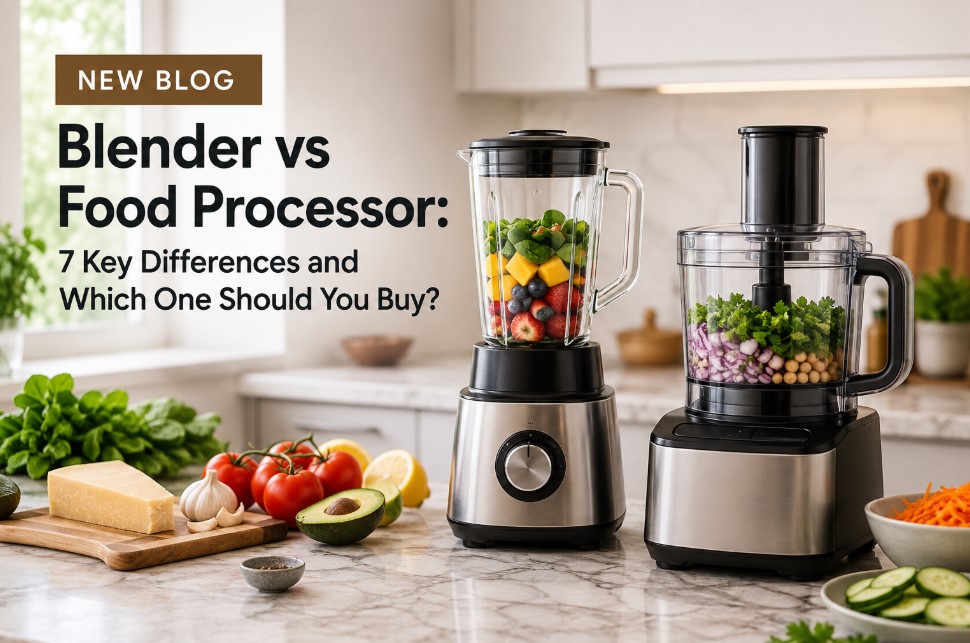
Choosing between a blender and a food processor can be surprisingly difficult. At first glance, both appliances seem to perform similar jobs: they have powerful motors, rotating blades, containers for ingredients, and controls that allow you to process food quickly. However, they are designed with different purposes in mind. A blender is mainly built for turning ingredients into smooth mixtures, while a food processor is designed for a much wider range of food-preparation tasks such as chopping, slicing, shredding, grating, mixing and processing solid ingredients.
The right choice therefore depends less on which appliance is more powerful and more on what you actually prepare in your kitchen. If smoothies, shakes, sauces, and creamy soups are part of your regular routine, a blender may be the more useful choice. If you spend more time chopping vegetables, shredding cheese, preparing dips, making dough, or handling large quantities of solid ingredients, a food processor may offer greater value. In this guide, we compare a blender and a food processor through seven important differences so you can decide which appliance makes more sense for your kitchen.
Blender vs Food Processor: What Is the Difference?
Before comparing the two appliances, it helps to understand their basic purpose.
A blender is designed to break ingredients down into a smooth or relatively smooth mixture. Its container is usually tall and shaped to help ingredients circulate toward the blades. Liquids play an important role in this process because they help move the ingredients around the container. This is why blenders are commonly used for smoothies, milkshakes, protein drinks, sauces, purees and creamy soups.
A food processor has a wider working bowl and is designed more around food preparation. Instead of concentrating primarily on smooth liquid mixtures, it is built to process solid and semi-solid ingredients in different ways. Depending on the model and included attachments, a food processor may chop vegetables, slice potatoes, shred cheese, grate ingredients, prepare dips, mix certain doughs and puree foods.
There is some overlap between the two appliances. A blender can process certain solid foods, while a food processor can handle some wet mixtures. The important point is that an appliance may be capable of doing a task without being the most convenient or efficient tool for that task.
If you are still learning the basics of blender technology and uses, “What Is a Blender?” is a useful place to start before comparing it with a food processor.

1. Blending and Chopping Performance
The biggest difference between a blender and a food processor is the type of processing each appliance handles best.
A blender is designed to create smooth mixtures. When you add fruit, liquid, yogurt, ice or other ingredients to a blender, the rotating blades create movement inside the container. Ingredients are pulled toward the blades, broken down and circulated again. This repeated movement helps produce the smooth consistency that people expect from a good smoothie or shake.
A food processor works differently. Its wider bowl and blade arrangement are better suited to chopping and processing solid ingredients. Rather than trying to turn everything into a completely smooth liquid, it can break food into pieces while giving you more control over texture.
For example, imagine that you need to chop onions for dinner. A food processor can process several pieces quickly and produce a chopped texture in a short amount of time. A blender is not designed for this job. Without enough liquid, the onion pieces may not circulate properly and the blades may process some pieces more aggressively than others.
The same difference can be seen with vegetables. A food processor can be useful when you need chopped carrots, onions, peppers or other ingredients for cooking. A blender would normally be more appropriate if those ingredients were being turned into a smooth soup or sauce.
This distinction is important because motor power alone does not determine whether an appliance is suitable for a particular job. Container design, blade shape, ingredient movement and intended use all contribute to performance.
Best choice for smooth mixtures: Blender
Best choice for chopping solid ingredients: Food processor
2. Smoothies, Shakes and Liquid Recipes
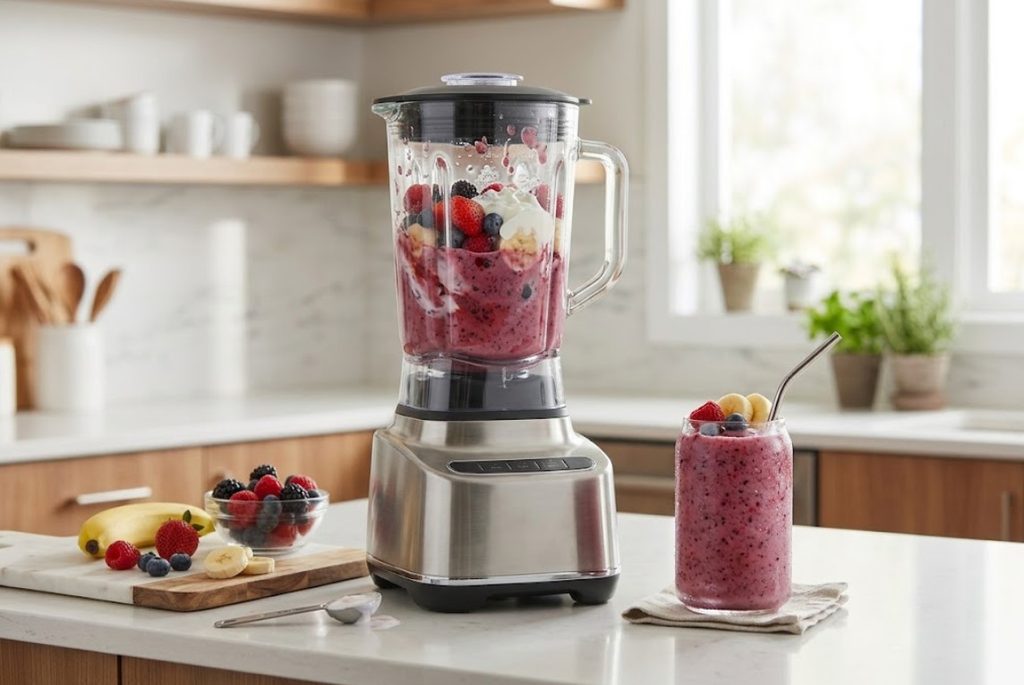
If smoothies are one of the main reasons you are considering a new appliance, a blender is generally the better choice.
Blenders are specifically suited to liquid-based recipes. Their jars are designed to encourage ingredients to circulate around the blades, allowing fruit, vegetables, yogurt, milk, water and other ingredients to combine into a smooth mixture.
This makes a blender useful for many everyday drinks, including fruit smoothies, green smoothies, protein shakes, milkshakes and frozen-fruit drinks.
Frozen ingredients are another area where blender design becomes important. A suitable blender can be designed to process ingredients such as frozen berries, frozen banana, and ice. However, not every blender performs exactly the same way. Motor strength, blade design, container shape and the manufacturer’s recommended use can all affect the result.
A food processor can process fruit and other wet ingredients, but it is not normally the first choice for preparing a smooth drink. Its wide bowl is better suited to solid ingredients, while the blender’s container encourages the movement needed for liquid mixtures.
For readers specifically interested in smoothie preparation, “Best Blenders for Smoothies: 7 Picks for Fast and Good Blending” provides a more focused look at blender options for this purpose.
The difference also matters when preparing sauces and purees. A blender is generally useful when the goal is a very smooth texture, while a food processor may be preferable when you want a thicker mixture with some texture remaining.
This does not mean a food processor is incapable of making wet mixtures. It simply means that the blender is designed around this type of work.
Best choice for smoothies and shakes: Blender
Best choice for many thick, textured food mixtures: Food processor
3. Chopping, Slicing, Shredding and Grating
This is one of the areas where a food processor has a clear advantage.
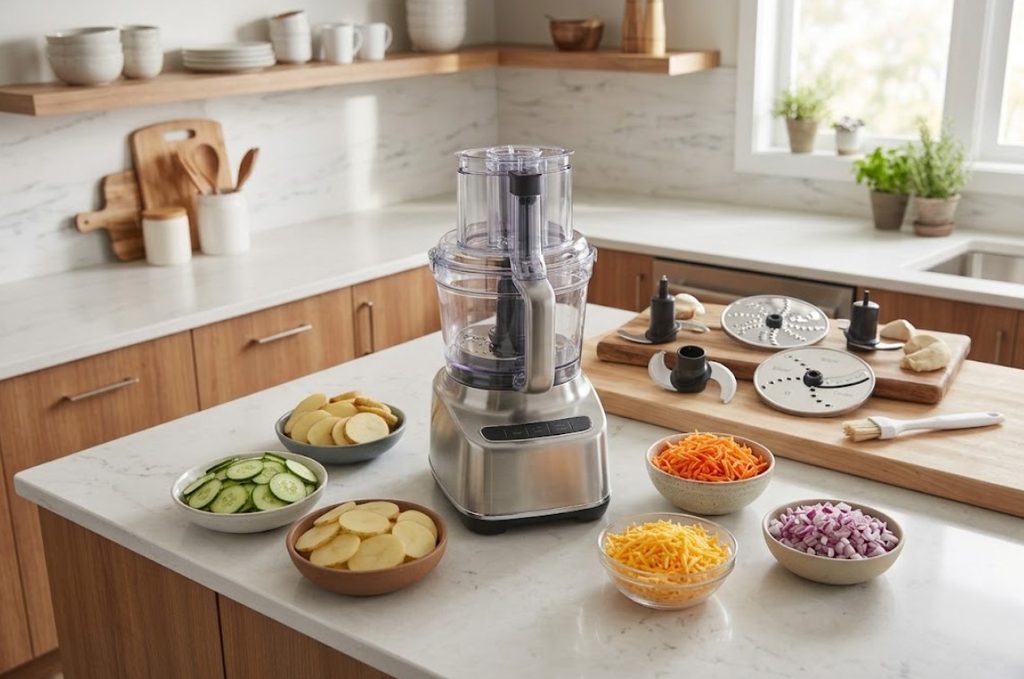
Many food processors come with different blades and discs designed for specific preparation jobs. Depending on the model, these may include chopping blades, slicing discs, shredding discs and other attachments.
That means one appliance can help with several repetitive kitchen tasks.
Imagine preparing a large family meal. You may need to chop onions, slice potatoes, shred carrots, grate cheese, and prepare vegetables for a salad. Doing all of this by hand can take considerable time. A food processor with the appropriate attachments can reduce much of that preparation work.
A blender is not normally designed for controlled slicing or shredding. Its blades are designed to break ingredients down rather than create consistent slices.
You can pulse ingredients in a blender, but the results may be less predictable. Some pieces can become very small while others remain relatively large. If you continue processing to make the larger pieces smaller, the already-processed pieces may become almost pureed.
A food processor gives you much more control for these preparation tasks.
This is especially useful for people who regularly cook from fresh ingredients. If your weekly cooking involves a lot of vegetable preparation, a food processor can save more time than a blender.
However, if you rarely chop large quantities and mainly want to make drinks and sauces, the additional attachments of a food processor may not provide enough value to justify the purchase.
Best choice for slicing, shredding and grating: Food processor
4. Capacity and Batch Size
Capacity is another important difference, especially for families and people who prepare food in larger quantities.
Both appliances are available in different sizes. You can find compact personal blenders designed for one drink, larger countertop blenders for several servings, small food processors for everyday preparation and larger food processors designed for bigger batches.
The important difference is how the available space is shaped.
A blender usually has a taller container designed around liquid circulation. This makes it excellent for smoothies and other drinks, but not necessarily ideal for spreading a large quantity of solid ingredients across a wide working surface.
A food processor usually has a wider bowl. This shape provides more room for solid ingredients to move around and can make it easier to process vegetables and other foods in larger quantities.
For example, if you are preparing vegetables for a family dinner, a food processor may allow you to process a useful quantity at one time. If you are making several servings of smoothies, a larger blender may be more appropriate.
Personal blenders can be particularly useful for individuals or couples who mainly prepare one serving at a time. They also tend to require less counter and storage space.
Before purchasing either appliance, consider how many people you normally cook for. A large appliance may provide more capacity than you need, while a small model can become frustrating if you regularly prepare family-sized batches.
Also pay attention to the manufacturer’s recommended maximum filling level. The advertised container capacity does not necessarily mean that every recipe should be processed at the maximum level.
Best for larger quantities of solid food: Food processor
Best for liquid batches: Blender

5. Dough, Dips and Heavy Food Preparation
Another important difference appears when you move beyond basic chopping and blending.
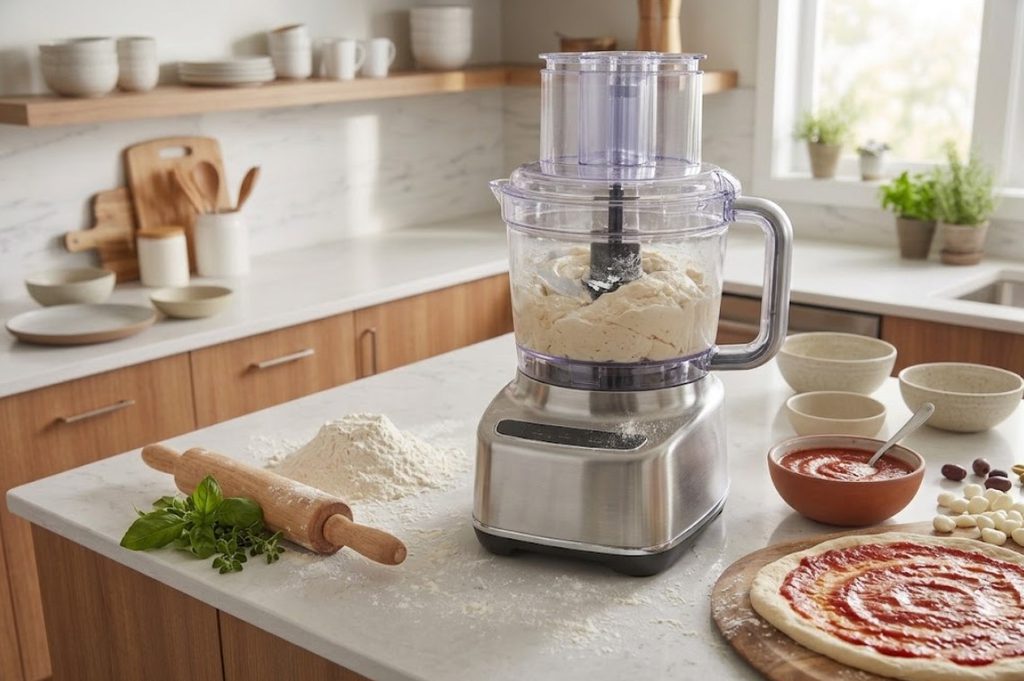
Some food processors are designed to handle certain types of dough and heavy mixtures. Models that include suitable dough blades can be useful for preparing bread dough, pizza dough, pastry mixtures and other recipes.
The exact capability varies between models, so you should always check the manufacturer’s instructions before using a food processor for a particular dough or heavy mixture.
A standard blender is generally not designed for kneading dough. Its container and blades are optimized for blending rather than developing or mixing dough.
This is a good example of why you should not choose an appliance based only on motor power. A powerful motor does not automatically make an appliance suitable for every type of food preparation.
Food processors can also be useful for dips and spreads. Hummus, pesto, certain thick sauces, and other textured mixtures can often be prepared effectively in a food processor.
Blenders can also make dips and sauces, especially when the desired result is smooth. The difference is often the texture you want.
If you want a very smooth sauce, a blender can be an excellent option. If you want a thicker spread with some texture remaining, a food processor may be more suitable.
For someone who frequently prepares homemade bread or pizza dough, this difference could be enough to make a food processor the more practical purchase.
Best choice for dough and many solid food preparations: Food processor
Best choice for smooth sauces and liquid-based mixtures: Blender
6. Cleaning and Ease of Use
Cleaning is easy to ignore when shopping for an appliance, but it can have a major effect on how frequently you actually use it.
A blender can be relatively simple after preparing a smoothie. Depending on the design, you may have a main container, lid, blade assembly and motor base. Some models have removable parts that make cleaning easier.
However, food residue can sometimes collect around the blades or in other areas of the container, so careful cleaning is still important.
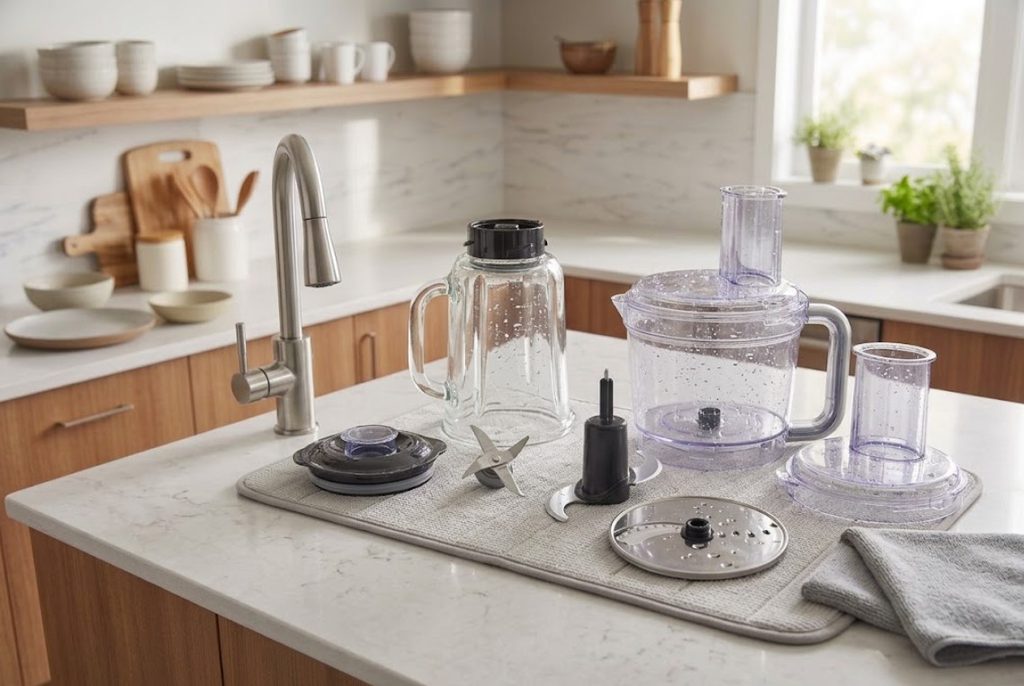
A food processor can have more components because its versatility often comes from multiple attachments.
A typical food processor may include a bowl, lid, main blade, slicing disc, shredding disc, feed tube, pusher and other accessories.
Those components make the appliance more versatile, but they can also mean more washing, drying, and storage.
Some models have dishwasher-safe components, which can make cleaning more convenient. However, dishwasher compatibility differs between products, so it is important to check the manufacturer’s instructions rather than assuming every removable component is dishwasher safe.
Ease of assembly matters too.
If you only want to make one smoothie every morning, assembling and washing multiple food processor parts could feel unnecessary. A simple blender may fit your routine better.
If you regularly prepare several ingredients for cooking, the additional cleaning may be a reasonable trade-off for the time saved during preparation.
Best for a simple smoothie routine: Blender
Best for versatility despite additional parts: Food processor
7. Storage, Versatility and Kitchen Space
The final difference is not just about what an appliance can do. It is also about how comfortably it fits into your kitchen.
A blender can be relatively straightforward to store. A typical countertop model consists of a motor base, container, lid and blade assembly. Personal blenders can be even more compact.
A food processor may require more storage because its versatility often comes from several blades and discs.
If you have a small kitchen, this matters.
An appliance that takes up too much cabinet or countertop space may eventually become something you avoid using. Before buying, measure the space where you expect to keep the appliance.
Think about both countertop space and cabinet space. Some appliances are heavy enough that moving them in and out of a cabinet every day can become inconvenient.
However, the additional storage requirement of a food processor can be worthwhile if you actually use its attachments.
One appliance that can chop, slice, shred, grate, puree and mix may replace several manual preparation tasks.
The key question is therefore not simply which appliance is more versatile.
Instead, ask:
Which appliance is more versatile for my kitchen?
If you mostly prepare smoothies, shakes, sauces and creamy soups, the blender may give you everything you need without taking up unnecessary space.
If you frequently prepare vegetables, dips, dough, shredded ingredients and larger quantities of solid food, a food processor may justify its larger collection of accessories.
Best for simple storage and liquid-focused use: Blender
Best for broader food-preparation versatility: Food processor

Which One Should You Buy?
After looking at the seven differences, the choice becomes easier when you focus on your own cooking habits.
Choose a blender if your kitchen routine mainly involves:
- Smoothies
- Protein shakes
- Milkshakes
- Frozen fruit drinks
- Smooth sauces
- Creamy soups
- Purees
- Liquid-based recipes
A blender is particularly useful when achieving a smooth consistency is important.
Choose a food processor if you regularly:
- Chop vegetables
- Slice ingredients
- Shred cheese
- Grate food
- Prepare dips
- Make pesto
- Prepare certain doughs
- Process larger quantities of solid ingredients
A food processor becomes more valuable when food preparation takes a significant amount of time.
There is also a third possibility: owning both.
For people who cook frequently and use their appliances for different purposes, having both can provide greater flexibility. The blender can handle smoothies and smooth liquid recipes while the food processor takes care of chopping, slicing, shredding, and other preparation tasks.
However, you do not need both simply because both appliances are popular. If one appliance can handle the majority of your weekly recipes, buying another may not be necessary.

When a Blender Is the Better Choice
A blender is the better choice when smoothness is one of your main priorities.
For example, someone who starts the morning with a fruit smoothie may get more daily value from a blender than from a food processor.
The same is true for someone who frequently prepares protein shakes, milkshakes, blended sauces, creamy soups or frozen drinks.
A blender can also be attractive to people who want a simpler appliance with fewer accessories.
If your cooking style is relatively straightforward and you do not regularly need slicing or shredding attachments, there may be little reason to buy a larger food processor.
The right blender still depends on your needs. A person making one smoothie per day may prefer a compact personal blender, while a family preparing several servings may benefit from a larger countertop model.
When a Food Processor Is the Better Choice
A food processor is the better choice when food preparation is the bigger part of your routine.
Someone who prepares vegetables from scratch several times a week can benefit from the chopping, slicing, and shredding capabilities.
It can also be useful for people who make homemade dips, spreads, pesto, pastry or certain types of dough.
The wider bowl and selection of attachments make it a more food-preparation-oriented appliance.
If you regularly find yourself spending a lot of time chopping and preparing ingredients by hand, a food processor may save more time than a blender.
Can a Blender Replace a Food Processor?
In some kitchens, a blender can cover enough food-preparation tasks that a food processor is unnecessary.
For example, if you mostly make smoothies and occasionally prepare a sauce, your blender may be all you need.
But a blender should not be viewed as a complete replacement for a food processor.
It is not designed to provide the same controlled slicing, shredding, grating, or chopping capabilities. Trying to force a blender into those roles can produce inconsistent results and may not be appropriate for the appliance.
The same principle works in reverse. A food processor can handle wet mixtures, but it is not necessarily the best tool for producing a completely smooth smoothie.
The better approach is to choose the appliance based on the jobs you perform most often.
What to Look for Before Buying
Once you decide between a blender and food processor, look beyond appearance and advertised motor power.
Motor and performance
Choose a model appropriate for the ingredients you expect to process. Frozen fruit, ice, nuts, dough and other demanding ingredients can place greater demands on an appliance.
Container or bowl design
Think about your normal serving size and batch size. A personal blender may be perfect for one smoothie but inconvenient for a family.
Controls
Simple controls can be sufficient for basic recipes. Variable speeds and pulse functions can provide more control when you want different textures.
Accessories
For food processors, check exactly what comes in the box. A model may appear inexpensive initially but become less attractive if important discs or attachments need to be purchased separately.
Cleaning
Consider how easily the parts can be removed and washed. If you expect to use the appliance frequently, easy cleaning can make a significant difference.
Storage
Measure your available space before buying. Consider the motor base, bowl or jar, lid, blades, discs and accessories.
Warranty and replacement parts
A kitchen appliance can be a long-term purchase. Check the warranty and availability of replacement components before making your final decision.
For current specifications, safety instructions, and model-specific capabilities, checking the manufacturer’s official product information before buying is a sensible final step.
Common Buying Mistakes to Avoid
One common mistake is choosing an appliance simply because it has the highest advertised wattage.
More power can be useful, but it does not automatically make a blender better at chopping vegetables or a food processor better at making smoothies.
Another mistake is buying a food processor when the main purpose is preparing drinks. While it may process fruit and other wet ingredients, a blender is generally designed more specifically for smooth liquid mixtures.
The opposite mistake is buying a blender and expecting it to replace every function of a food processor.
It is also easy to underestimate storage. Before purchasing a food processor with several attachments, think about where you will keep those accessories.
Price is another factor to consider carefully. The most expensive appliance is not automatically the best appliance for your kitchen. What matters is whether its features match your actual needs.
Instead of asking, “What is the most powerful appliance I can afford?” ask:
“What will I use this appliance for every week?”
That question can lead to a much better purchasing decision.
Final Verdict
A blender and a food processor are best viewed as different kitchen tools that overlap in some areas rather than complete replacements for each other. A blender is generally the better choice for smoothies, shakes, creamy soups, smooth sauces, purees, and other liquid-based recipes. A food processor is generally more useful for chopping, slicing, shredding, grating, dips, solid ingredients, and certain dough preparations.
If smoothies and liquid recipes make up most of your routine, a blender is likely to give you the better value. If preparing vegetables, dips, dough and other solid foods takes up more of your time, a food processor may be the smarter purchase. If you regularly do both, owning both can eventually make sense—but only if your cooking habits and available kitchen space justify it.
Before choosing a blender or food processor, it is worth checking the official manufacturer’s specifications, care instructions and recommended uses for the model you are considering, because features such as motor performance, included attachments, maximum capacity, and dishwasher-safe components can vary between products. These details can help you confirm whether an appliance is suitable for the recipes and preparation tasks you plan to handle regularly.
Frequently Asked Questions
Is a blender better than a food processor for smoothies?
Yes. A blender is generally better suited to smoothies because its container and blade design are optimized for liquid-based mixtures and smooth consistency.
Can a food processor replace a blender?
Not completely. A food processor can handle certain wet mixtures, sauces and purees, but it is generally not the ideal replacement for a blender when making smooth drinks.
Can a blender replace a food processor?
Not completely either. A blender does not normally provide the same slicing, shredding, grating and controlled chopping capabilities available with many food processors.
Which is better for chopping vegetables?
A food processor is generally the better choice, especially when you need to process larger quantities or want consistent pieces.
Which is easier to clean?
A blender often has fewer components, making it simpler for some everyday tasks. However, the exact cleaning experience depends on the design of the individual appliance.
Is a food processor worth buying if I already own a blender?
It can be worthwhile if you frequently chop, slice, shred, grate, prepare dips or make certain types of dough. If you mainly make smoothies and blended drinks, your existing blender may already cover most of your needs.
Which should I buy first: a blender or food processor?
Think about your most common recipes. Choose a blender first if smoothies, shakes, sauces, and creamy soups are common in your kitchen. Choose a food processor first if chopping, slicing, shredding, grating and solid-food preparation are more important.
Can I use both appliances for the same recipes?
Sometimes. Both can handle certain purees, sauces, dips, and other mixtures, but the final texture and convenience can differ. The appliance designed for the specific task will generally be easier and more efficient to use.